
Put a line of shortbread fingers on a table and it looks like a simple packaging task. The pieces are all the same, the colors are known, and the setting itself almost makes the composition.
Now put the same biscuits in a tin with a tray, a sealed bag and a lid.
The longer pieces can get caught in the cavity. The little ones leave enough room to slip through. Paper cups are bigger than their nominal diameters. The top layer is lifted by a folded bag seal. After a brief handling test, crumbs have accumulated in one corner and the set-up no longer looks as generous as in the rendering.
That’s where the packaging for shortbread moves beyond a simple tin-selection exercise.
Shortbread is crumbly, often butter rich and associated with giving away. Its packaging has to protect the product, and make a biscuit that looks relatively plain feel special. If the range is seasonal, the pack also needs to arrive in time, be for a limited selling period and not leave the brand with unusable dated stock.
The best way to deal with this is to treat the tin, inner pack, artwork and transport packaging as a system, and to keep that system as stable as possible when new seasonal designs are introduced.
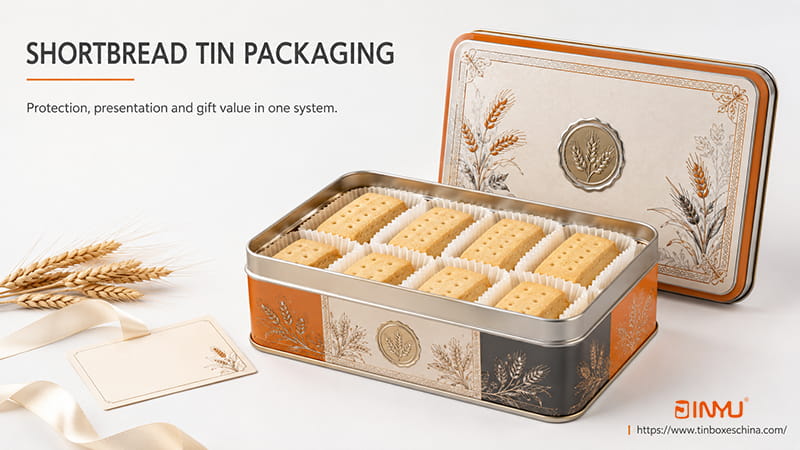
A premium core tin should be identifiable. Its structure and visual language must be sufficiently consistent to sustain repeat sales and repeat production.
A seasonal shortbread tin should not be new. But it does not require a new mold, new insert and new carton every time the artwork changes.
| Decision area | Premium core range | Seasonal gift range |
| Main purpose | Build long-term brand recognition | Create occasion relevance and buying urgency |
| Design life | Single season or limited campaign | Multiple seasons or repeat business |
| Artwork | Restrained & Brand-led | Expressive & Theme-led |
| Decoration | Embossing, metallic detail or premium varnish | Seasonal illustration, color changes and limited edition details |
| Structure | Standard format suitable for replication | Current structure revitalized with artwork where possible |
| Main risk | Inconsistency between orders | Missing selling window or holding dated stock |
| Reuse direction | Suitable for general household storage | Decorative, collectible or commemorative use |
We give buyers one simple principle:
Keep the engineering secret. Let most of the changing be done by the seasonal art.
Shortbread is generally shaped into fingers, rounds, squares and segmented wedges. The crumbliness is part of the appeal, but it also creates edges, corners and narrow sections that are prone to movement.
The technical overview from the American Society of Baking describes shortbread as a crumbly biscuit made from butter in a number of familiar shapes. Those traits drive pretty much every packaging decision.
Common packaging problems often occur in clusters:
Shortbread does not always behave the same way. Its strength is defined by thickness, moisture, formulation, baking profile and cooling.
Thus the word “shortbread” does not provide a tin manufacturer with sufficient information to choose a structure. We need to see the finished product and how it will actually be packed.
A request for “a tin that contains 400 grams” is commercially useful but technically incomplete.
The same weight could be one visible layer of big fingers, two layers of compact rounds or a few individually wrapped portions. Each arrangement demands a different internal footprint.
Before you pick a tin, check:
It is not always the best looking biscuits in the best looking carton that are the most useful when samples arrive at our factory.
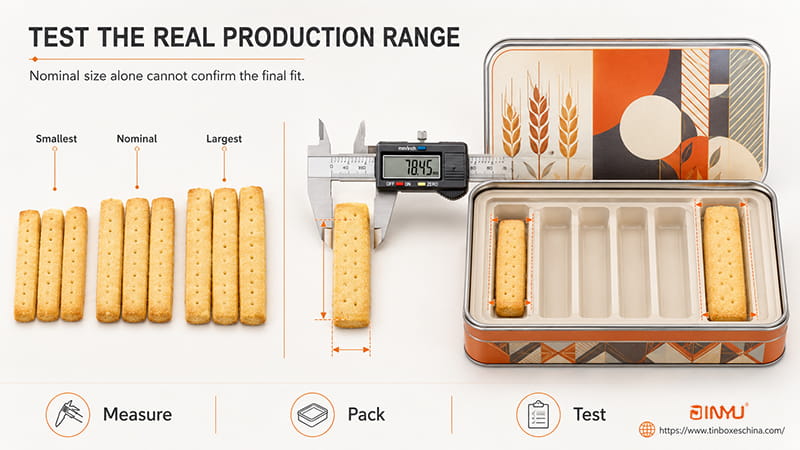
We need to see the normal production range – the finger that’s a bit longer, the piece that’s thinner, the biscuit that has the less perfect edge. These pieces indicate whether the proposed cavity is really workable.
The whole of the tolerance count. The cavity that holds the smallest biscuit may be too small for the largest biscuit. Designing only to the nominal measurement conceals that conflict until packing begins.
For a detailed capacity method, see How Many Cookies Fit in a Tin?. Final count should always be confirmed by a physical pack-out with production representative biscuits and intended inner packaging.
Shortbread fingers don't have to be in a rectangle and a round biscuit doesn't have to be in a round tin. Still, matching the two geometries often improves space use and makes movement easier to control.
| Shortbread style | Convenient tin direction | Biggest win | What to watch out for |
| Fingers | Rectangular or square tin | Regular rows and efficient use of length | End clearance, finger width and layer height |
| Individual rounds | Round, square or shallow rectangular tin | Permits radial or grid arrangements | Perimeter gaps and movement between pieces |
| Petticoat tails or wedges | Round tin | Suitable for traditional circular arrangement | Center gap, outside clearance and lifting method |
| Mixed selection | Square or rectangular tin | Easier to separate in visible zones | Different heights of product and dimensions of cells |
| Decorated seasonal shapes | Shallow presentation tin | Ensures visibility of shapes after opening | Cavity fit, top clearance and transport stability |
The shallow tin is often the strongest presentation as the consumer sees the assortment immediately. It also prevents stacking of multiple layers.
A deeper tin gives you more capacity for a smaller footprint, but the internal structure is more important. Separate trays, layer pads or wrapped groupings may be required to prevent the upper biscuits loading directly onto the biscuits below.
Either way is not automatically premium. The right option will depend on the product, the retail price, the shipping method and the desired opening experience.
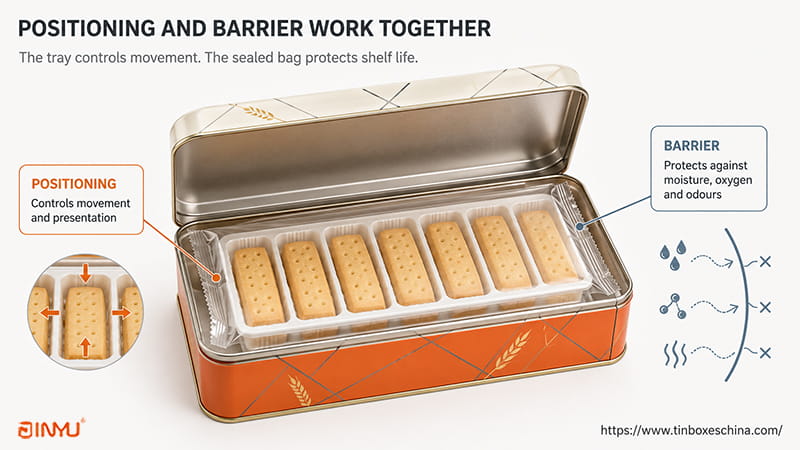
Internal packaging has two jobs pulling in opposite directions.
It must hold the shortbread firm, but it must not crush it.
A PET tray is repeatable in positioning and good if each piece needs to face the same direction. For a softer, more traditional bakery look, opt for paper cups. Dividers divide flavors or product groups. Stacked arrangements are separated by layer pads. The inner bag can be sealed to be the main barrier to oxygen or moisture.
None of these components does everything.
A divider can separate flavors without stopping movement. A paper cup can improve presentation, but not vertical lift control. A barrier bag may preserve shelf life and allow the biscuits inside it to slide. A tray that holds the product in place may reduce usable capacity more than expected.
When we do a packing review we build the full system:
Then we can see the rest of the clear.
There is no single top-gap measurement for shortbread. There must be enough space left so as to avoid compression, but not so much that the biscuits can accelerate before colliding with the tray, wall or adjacent product.
For a detailed comparison of the components available, see Cookie Tin Inserts Compared: PET Trays, Paper Dividers, Paper Cups and Inner Bags.
The body and lid are solid metal tins that block light. This is good for butter-rich biscuits, and products with nuts or chocolate.
It doesn’t make a standard decorative tin air-tight.
Slip lids, plug lids and other typical gift tin closures can feel tight yet allow for slow exchange with the surrounding atmosphere. Usually the extra protection needed against moisture or oxygen is provided by a correctly specified and sealed inner bag.
Storage studies on packaged biscuits have assessed changes in moisture, water activity, texture and lipid-oxidation markers with different materials and conditions. The buyer’s takeaway is pragmatic: the film specification is a starting point, not a shelf-life guaranty. See Effect of Different Novel Packaging Materials on Quality of Biscuit During Accelerated Storage.
When checking an inner bag, ask:
“High barrier” is not a full specification. Also, a single transmission rate number is useless without the test conditions.
The shelf-life decision must be based on testing the actual shortbread, film, seal and storage conditions together. The tin should be designed around the selected inner pack.
A standard tin is not by default airtight. The tin and inner packaging share the work of keeping the cookies fresh, as discussed in How Cookie Tins Help Keep Cookies Fresh.
Premium does not start with embossing.
It all starts when you open the lid and the shortbread is right where it said it would be in the artwork.
As long as that basic experience is right, ornament can be added. Shortbread is a great product for restrained design, as it is already associated with traditional baking, sharing and gifting.
A good quality shortbread tin might use:
In a piece review we usually ask the buyer to rank the decorative priorities.
Which color should stay the same? What should the customer feel? Where should light be reflected? What’s the glue that holds the brand together from product to product?
It is easier to remove unnecessary effects with those jobs assigned.
Illustration can be in CMYK. A Pantone color can set a key tone for your brand. Exposed metal or transparent color can be used to create small reflective details. Embossing can highlight a logo or a simple graphic. Varnish controls the reflection and mood.
It’s rare that running a process over the entire lid makes the tin feel more premium. This is normally less of an obvious hierarchy.
Important colors and finishes should be approved on printed metal and not on a monitor or office print. It is influenced by the reflection of the tinplate, the white base layer and the final varnish.
Embossing also needs to be checked against the formed lid, not just the flat artwork. In contrast, small registration differences can be very visible when you have printed lines that depend on exact alignment with a raised shape.
We discuss these in our guide to printing cookie tins with CMYK, Pantone colors, metallic effects and embossing.
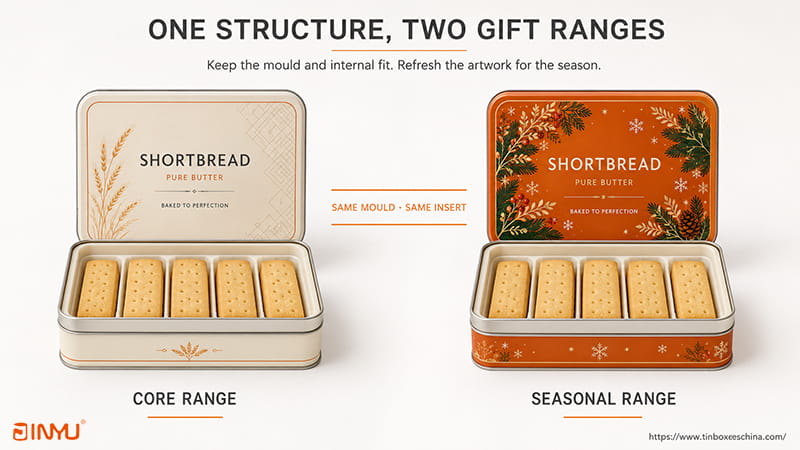
You can get carried away with changes to the packaging system, and the seasonal refresh can be costly.
When reviewing, it is helpful to split the specification into two columns: what stays and what changes.
First column is usually the mold, the internal dimensions, the layout of the tray and the master-carton. The second is for artwork, support colors, paper sleeves and campaign messages.
If the “changes” column gets too many items, the project is no longer a seasonal refresh. It's a new packaging program.
Whenever possible, please keep the following:
Change the bits that consumers really need to see:
This doesn’t mean bypassing approval. Each printed design still requires color review and production planning. If the seasonal recipe or biscuit size changes, the pack-out and shelf-life work has to be repeated too.
But the project doesn't start from a blank page each year anymore.
Printing a year on the metal can be used in support of a commemorative or collector concept. It also helps to make remaining stock visibly out-of-date.
If the selling period is indefinite, use a removable sleeve, label or card to indicate the year or temporary promotion. A wider winter-gifting design might also have longer commercial utility than a purely Christmas-only design.
A customer might request we do one evergreen shortbread tin and one Christmas edition.
We would try to keep the engineering quiet at first, and let the artwork do most of the talking.
The core version can use:
The Christmas variant could keep:
The difference between seasons could then be due to:
The consumer sees two different products. A handful of changes are seen by the production team.
It’s a much stronger foundation for a repeat gift program than developing a new shape, tray and carton for each design.
Before recommending new tooling at Jinyu, we look at our library of over 3,000 existing molds. If the current structure supports the needed product layout and brand presentation, the development budget can still be concentrated on the areas the customer will see.
We tend to use a solid lid for the premium shortbread.
It gives more artwork space, hides crumbs and bag folds, blocks light from the lid direction and works naturally with opaque barrier packaging. It also allows the designer more freedom to utilize embossing or a large center illustration.
A window is more useful if the product itself has visual value. It could be an unusual shape, a decorated surface, an appealing caramelized edge, or a carefully arranged selection.
Still we would pass the window only after we had packed real production biscuits and checked:
If the primary barrier is a bag that isn’t see-through, the window may not show the shortbread, only the bag.
See Window Lid or Solid Lid? for a more detailed comparison. Selecting the Appropriate Tin for Biscuit Packaging.
A premium shortbread tin has to feel right where the customer actually sees it.
Supermarket shelves demand instant brand recognition, unambiguous flavor differentiation, dependable stacking and effective case packing.
Gift shops and tourist retail are more about location, tradition, storytelling and souvenir appeal.
E-commerce adds parcel handling, product photography and the danger of the arrangement changing before it is delivered.
In particular, approval dates, logo treatment and delivery dates are important for corporate gifting. For smaller branded variations, a sleeve or a label might be more practical than a new printed tin.
Hampers impose another size restriction. The tin needs to sit next to tea, coffee, chocolate or other products efficiently without requiring a larger outer gift box.
The structure that looks most impressive on its own is not always the one that works best in the complete retail program.
A dented tin and a broken shortbread finger are two different kinds of failures.
The tin damage is affected by the retail protection, master carton, pallet pattern and stacking load. Shortbread damage is highly dependent on internal clearance, positioning, layer pressure and repeated movement.
One can occur without the other.
The final transport test should therefore be performed on the complete system: production representative shortbread, final inner bag, insert, tin, retail protection, master carton and intended pallet arrangement.
Testing an empty tin does not prove that the biscuits will survive. How a tray performs outside its final carton does not, however, prove export performance.
For the complete transport checklist, see How to Avoid Dented Cookie Tins & Broken Cookies During Export Shipping.
Seasonal packaging has a commercial deadline – not just a factory completion date.
Begin with the required warehouse or retail date and work backward through:
Late changes in artwork can be particularly disruptive if they affect embossing, metallic areas, statutory text or the number of designs.
A late Christmas tin doesn’t just show up a few weeks late. It can lose a big chunk of its selling window.
Our Christmas cookie tin production timeline gives a detailed way to plan.
If you are on a tight budget, buy the parts that make the product land correctly first.
A reasonable priority is:
A good artwork standard existing mold with a reliable insert can create a stronger premium product than an expensive custom shape with weak internal packaging.
Quotation should also confirm food contact requirements. Don’t wait until production is complete to request documents for the internal coating, tray or inner bag. Late requests can reveal document gaps, require more testing or delay shipment.
See Food-Contact Documents for Cookie Tins – What Buyers Should Request for the component level checklist.
The number of seasonal designs will also effect the cost. The MOQ for custom printing is per size and per design. Splitting an order into too many artworks can lead to inefficient quantities.
Ask suppliers to break down the cost of:
Our custom cookie tin quote breakdown shows how these factors influence the unit price.
A shortbread tin may come in handy after you have eaten the product. Consumers can re-use it for tea, stationery, sewing supplies, photographs or storage at home.
Brands can help increase the chances of this by selecting artwork that is still attractive after the holiday season, avoiding too many temporary details and making sure the lid still works perfectly.
Reusability may add to the packaging experience, but should not be taken as an automatic indication of a lower environmental impact. Depends on material use, production, transport, recycling and if the consumer actually keeps and uses the tin.
See Practical Illustrations of How to Reuse Cookie Tins.
A good request for quotation should contain ten main items:
If some information is still in development, mark it as provisional. Assumptions can be used for a preliminary quote but must be replaced by confirmed specifications before tooling and production.
The most troublesome mistakes are generally the common ones:
Most of these problems are inexpensive to fix in development. They cost a lot more once the printed metal, tooling or finished tins are in place.
Rectangular and square tins usually allow for fingers and grid arrangements. Round tins go naturally with rounds, wedges and petticoat tails. The final decision should be the real product, count, inner packaging and opening presentation.
One is used in many commercial shortbreads as a standard gift-tin closure is not inherently air-tight. The film and seal must be selected according to the recipe, shelf-life target and storage conditions.
A PET tray allows you to position it more precisely. Paper cups offer traditional bakery presentation and ease of lifting pieces. Depending on whether movement control, appearance, packing speed or plastic reduction are the priority the correct choice will vary.
There is no magic number. Test the smallest and largest acceptable biscuits with the final tray, packed bag, pads and production tin. The pack should not compress, but it should not permit a lot of movement either.
A solid lid is often a safer bet to start, as it gives you room for artwork and conceals crumbs and bag folds. A window works when the product is visually distinctive and remains in place after transport.
There are no premium finishes. Matte and soft-touch finishes tend to mute colors and illustrations, while gloss makes them pop. Embossing and metallic details are most effective when used as a single center of attention.
Yes. Insert and carton with a proven structure and changing artwork is often an efficient way to build a seasonal range. Each printed design will still have its own approval and production quantity.
Count back from the warehouse or retail date. Allow for pack-out development, artwork, metal proofing, sampling, mass production, inspection and freight. It takes time for new tooling and multiple designs.
Jinyu’s minimum order quantity is 5,000pcs per size and design. If a number of seasonal artworks are planned, discuss quantity allocation before finalizing the range.
The biscuit is the starting point for a successful shortbread tin but it’s the whole gift experience that it’s built around.
The structure has to match the real product. Inner packaging must retain position but not apply damaging pressure. The barrier pack must be able to meet the stated shelf life. Artwork must speak value without overshadowing the brand.
And when those parts are working, that same dependable foundation can spawn an evergreen premium tin and a seasonal gift edition.
If you are designing custom shortbread tin packaging please tell us the finished biscuit size, number of biscuits, packing layout, number required, destination market and retail deadline. We can look at existing suitable molds, locate the places for physical tests and get the project ready for sampling.
Lead times depend on project specifications, tooling, artwork approval, production scheduling and quantity ordered.

Holen Sie sich die neuesten Informationen und Sonderangebote


 IPv6-Netzwerk unterstützt
 Deutsch
 English
 Français
 Español
 Português