
Finishing the last biscuit doesn't have to mean the end of the package.
A well-made cookie tin is rigid, easy to handle, and often attractive enough that throwing it away feels wrong. That's why so many households have at least one old biscuit tin holding buttons, photographs, cables, or something entirely unrelated to biscuits.
If you're wondering how to reuse cookie tins, this guide covers the most practical options — from everyday storage to creative DIY projects — and explains when a tin should move on to recycling instead.
There's also a section at the end for packaging buyers and brand owners. If you're designing cookie tins that customers will want to keep, the way people actually reuse them is useful feedback.
Not every empty tin should automatically be reused.
Look at the inside, rim, lid, and seams. Minor scratches on the outside may only affect appearance, but rust, exposed sharp edges, badly distorted rims, or a damaged internal coating are different matters.
| Condition of the Tin | Best Next Step | Examples |
| Clean, dry and undamaged | Consider suitable reuse | Packaged dry foods, tea bags, gifts, stationery |
| Cosmetically worn but structurally sound | Prefer non-food reuse | Sewing supplies, cables, crafts, keepsakes |
| Rusty, sharp, badly crushed or internally damaged | Stop using it | Check local recycling or disposal guidance |
If a tin's interior coating is scratched, worn, or damaged, the tin should not be used for loose food. Even a tin that looks clean may have microscopic wear that makes direct food contact unwise.
For food reuse, follow these rules:
The tin must be clean, dry, and free of interior coating damage
Loose dry foods like biscuits should be placed in a food-safe liner or sealed inner bag — never directly against an old tin surface
Individually wrapped tea bags, coffee sachets, and sealed confectionery are safer options because they don't contact the tin
Moist, perishable, or temperature-sensitive products need proper refrigeration regardless of what container they're in
Never reuse a tin for food if it previously held non-food items like craft supplies or hardware
If in any doubt, use the tin for non-food storage instead. A slightly worn tin still has years of useful life as a desk organiser or craft box.
Decorative cookie tins benefit from gentle cleaning. Long soaking, abrasive scrubbers, and trapped moisture can damage the surface or encourage corrosion around seams and rolled edges.
A practical routine:
Remove crumbs and loose debris with a dry cloth first
Hand-wash with warm water, mild detergent, and a soft sponge
Avoid abrasive pads that could scratch decoration or coating
Rinse carefully
Towel-dry immediately
Leave the lid open until the rim, corners, and seams are completely dry
Once clean, smell the interior. If an odour remains or you find rust or coating damage, move the tin to a non-food use.
These are the reuse ideas we see most often — and the ones that tend to last longest because they match what the tin naturally does well.
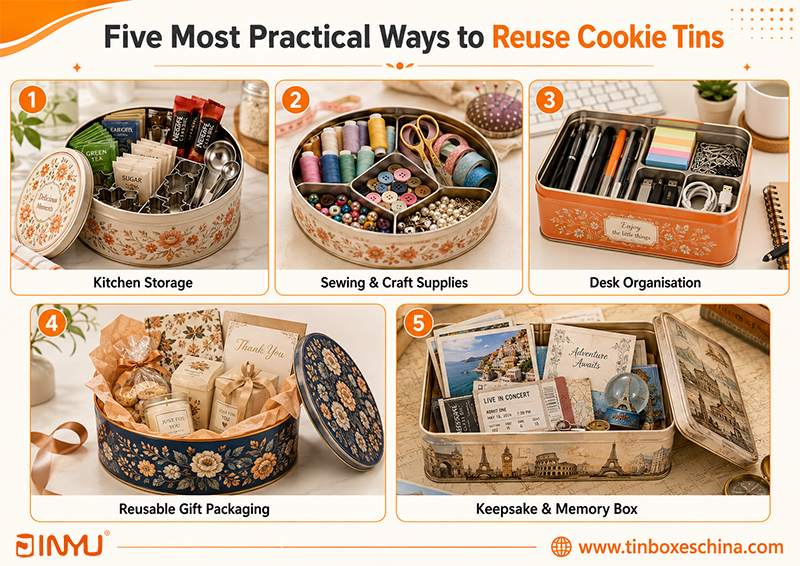
The kitchen is the most obvious place to give a biscuit tin a second job.
Best candidates: Tea bags, coffee sachets, sugar packets, individually wrapped drink mixes. A shallow round tin can sit beside a kettle; a taller rectangular tin can hold several varieties of wrapped tea.
For bakers: A round cookie tin makes an excellent home for cookie cutters, piping tips, reusable cake decorations, and measuring tools. Instead of searching several kitchen drawers, everything stays together in one container.
For dry homemade biscuits: Only use a tin that is clean, undamaged, and fitted with an appropriate food-safe liner or inner bag. Cookies must be completely cool before packing — trapped warmth creates condensation.
The biscuit-tin sewing box is a household tradition for good reason.
Shallow tins make thread, buttons, tape, patches, and small scissors easy to see. Needles and pins should go in a smaller secure holder rather than loose inside the metal box.
The same idea works for craft supplies: crayons, stickers, ribbons, beads, decorative tape, and small paper pieces. A tin creates defined storage without another plastic organiser.
Larger tins can be divided into sections using removable cardboard dividers — a simple way to turn one large cavity into several smaller storage zones.
Old cookie tins work surprisingly well in home offices.
Paper clips, spare pens, USB drives, charging cables, memory cards, sticky notes, and small adapters all tend to disappear into drawers. A small tin becomes a dedicated cable box. A rectangular tin works for pens and leads. A shallow round container suits clips and small accessories.
Labelling the underside of the lid identifies the contents without covering an attractive exterior design.
One of the simplest forms of reuse is to let the tin become packaging again.
Add tissue paper or an appropriate inner liner and fill the tin with stationery, wrapped sweets, tea bags, photographs, small self-care products, or another lightweight gift. This works especially well around Christmas, birthdays, and other occasions when gift wrap accumulates quickly.
The recipient gets two things at once: the gift and a container they can potentially reuse. If homemade food is included, use appropriate inner packaging and provide any relevant ingredient, allergen, and storage information.
Some cookie tins are simply too attractive to repaint. Preserving the original artwork may be more interesting than hiding it.
A clean, dry tin can hold postcards, greeting cards, concert tickets, printed photographs, children's drawings, and small travel souvenirs. For valuable photographs and irreplaceable paper items, place them in archival sleeves and keep the tin somewhere dry and away from strong sunlight.
This is one reason decorative biscuit tins often survive far longer than the products originally packed inside them: the graphics gradually become part of the object.
These options require a little more effort but can work well for the right tin.
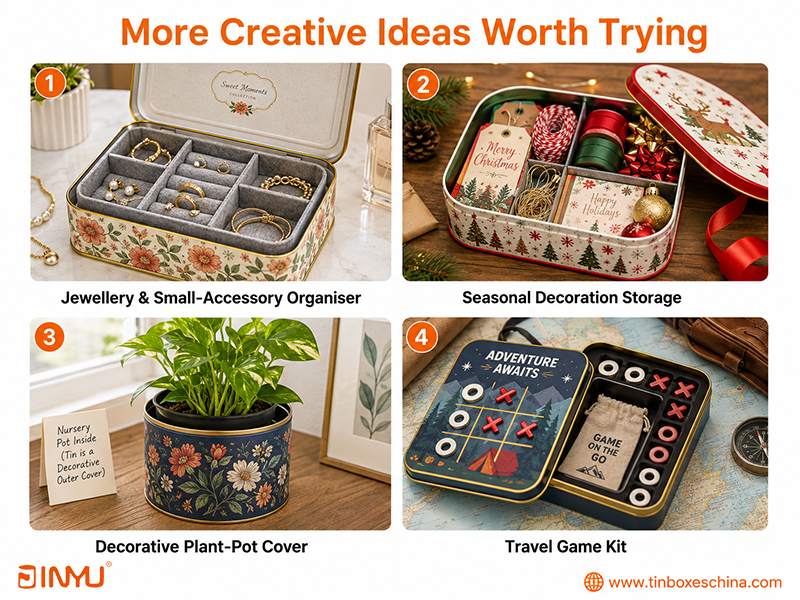
Jewellery and small-accessory organiser: Add a removable felt base to reduce contact between jewellery and metal. Small cardboard or fabric-covered dividers separate earrings, rings, and bracelets. For collectible tins, use removable liners rather than permanent alteration.
Seasonal decoration storage: Holiday tins tend to arrive at exactly the time people acquire lots of small seasonal items. Use them for gift tags, ribbons, bows, ornament hooks, spare cards, and small decorations. The exterior artwork already hints at what's inside.
Decorative plant-pot cover: Keep the plant in its watertight nursery pot and use the tin as an outer decorative cover. Remove the inner pot before watering, allow excess water to drain, then place it back. This avoids rust and drainage problems.
Travel game kit: A shallow metal tin with magnetic pieces can become a portable tic-tac-toe board, puzzle set, or letter kit. The lid becomes the playing surface; all pieces stay inside when packed away. This is genuine upcycling — the container's structure becomes part of the new product.
Cookie tins come in many formats, and their shape often suggests the easiest use.
| Cookie Tin Format | Reuse Ideas That Fit Naturally |
| Shallow round tin | Sewing supplies, jewellery, craft pieces, cookie cutters |
| Deep round tin | Seasonal decorations, yarn, larger household items |
| Rectangular tin | Stationery, cables, photographs, cards, travel kits |
| Square tin | Tea bags, craft supplies, small gift sets |
| Tall cylindrical tin | Long tools, brushes, packaged tea, decorative storage |
This principle is useful for consumers and packaging designers alike: the more practical the proportions remain after the original product is gone, the easier it is for the package to earn a second life.
You can — but not every tin needs it.
Paint, fabric, removable vinyl, paper bands, and decoupage can completely change the appearance of an ordinary container. For a plain or heavily seasonal tin you want to use year-round, redecorating makes sense.
For an attractive branded, vintage, or collectible tin, consider using removable labels, ribbon, or an inner liner instead. Preserving the original artwork may ultimately make the object more interesting.
Any paint, coating, or adhesive should be used according to manufacturer instructions, and materials not intended for food contact should stay away from food-contact surfaces.
Reuse is useful only while the tin remains useful.
If a container is badly rusted, contaminated, severely crushed, sharp, or impossible to clean properly, keeping it simply because it could theoretically be reused defeats the purpose. At that stage, check the recycling rules that apply where you live. Steel is widely recyclable and can re-enter the material stream through established collection systems.
The sensible principle is straightforward: keep a cookie tin in use while it remains safe and genuinely useful. Recycle it responsibly when it no longer is.
For packaging buyers and brand owners, the way consumers reuse tins offers practical design feedback.
A biscuit tin that people naturally want to keep usually has several characteristics working together:
Practical proportions: A shallow round tin that fits in a drawer; a rectangular tin that suits standard shelf heights
A lid that remains functional after repeated opening: No bent hinges, no lost slip lids, no closures that weaken after a week
Artwork worth keeping: Designs that are attractive rather than purely promotional
Season-neutral visuals: Tins without heavy Christmas or Valentine's branding stay in use all year
A finish that ages reasonably well: Matte and textured surfaces hide wear better than high-gloss mirror finishes
None of these outcomes needs to be guaranteed in marketing copy as a "reuse promise." They are simply useful design considerations when developing packaging intended to have value beyond the first opening.
We've seen this principle play out in our own production work at Jinyu. Clients who choose durable finishes, balanced proportions, and artwork with lasting appeal tend to receive more unprompted customer feedback about keeping and reusing the tin. That secondary use extends brand visibility — a tin holding sewing supplies on a shelf is still carrying the brand name, months or years after the biscuits are gone.
If you're developing a cookie tin for your brand and want to discuss finishes, shapes, or internal layouts that support both product freshness and long-term reuse, we're happy to share what we've learned from the production side.
They can be reused for tea bags, baking tools, sewing supplies, stationery, craft materials, photographs, jewellery, gift wrapping supplies, seasonal decorations, and reusable gift packaging. The most practical second use depends on the size, shape, and condition of the tin.
A clean, fully dry, and undamaged tin may be suitable for dry homemade biscuits when an appropriate food-safe liner or inner package is used. Allow baked products to cool completely before packing. If the interior coating shows any wear, use the tin for non-food storage instead.
Not necessarily. A fitted lid may close securely, but this alone does not prove airtight performance. Products requiring strong moisture, oxygen, or aroma protection should use appropriate inner packaging.
Hand-washing is the safer approach for decorative tins. Prolonged moisture, heat, and detergent may affect printing, coatings, and seams. Gentle hand cleaning with thorough drying is recommended.
The easiest method is to use it as a decorative outer pot with a separate watertight nursery container inside. This keeps wet soil and standing water away from the tin.
Reuse it when it remains safe and has a real practical purpose. If it becomes badly rusted, damaged, or unsafe, check your local metal-packaging recycling rules.
The most useful answer to what to do with old cookie tins isn't to keep every container forever.
It's to look at the shape, condition, and design and find a second purpose that genuinely suits it. A tin that once protected biscuits might spend the next few years holding sewing supplies, photographs, tea bags, or Christmas decorations. Another might return to gift duty. Eventually, when it is no longer safe or useful, the metal can move on through the appropriate recycling route.
And for brands, that second life is worth thinking about too. A well-designed cookie tin doesn't have to stop being useful when the last biscuit disappears — and every day it stays in someone's home, it's still working.
Jinyu produces custom cookie tins for brands, importers, and packaging distributors. If you're developing a biscuit tin and want to discuss shapes, finishes, internal trays, or artwork that supports both product freshness and lasting consumer appeal, get in touch with your specifications and a rough order quantity. We'll suggest suitable existing moulds where possible, and guide you through sampling, printing, and production.

Holen Sie sich die neuesten Informationen und Sonderangebote


 IPv6-Netzwerk unterstützt
 Deutsch
 English
 Français
 Español
 Português