
3 flavours. Tin, one size. A total of 5,000 pieces order.
Seems pretty straightforward until the quote asks for a quantity against each design. For the buyer, top-down, it is matching tins in one product range. From the production side, the artwork, components and required quantities still have to be checked separately.
The useful question is what parts of this order can be produced together and what still need their own arrangements?
A purchase order groups together what you are buying. It does not dictate how the factory has to make it.
A version of an artwork identifies a particular print design. The finished SKU is what you receive, with its designated components and packing. A production batch is a group of items for a manufacturing operation. Those boundaries don't always line up.
For example, the same printed tin with two different inserts can create two finished SKUs without having to change the tin artwork. Alternatively, one tin size with three different printed tops offers three artwork versions.
Ask what the quoted MOQ is for. The size, printed design, component or finished combination. Write that base next to the quantities.
Please provide the supplier with a list of differences and not just 3 attractive mock-ups. Small visual changes can be important to production . Visually different packs may still have useful components .
| Order of change | What is to be shared | What else are we going to see? |
| Different flavour, same size art | Structural tooling and its associated forming steps | Print layout, colours and quantity per design |
| Common body, different lid art | Same body parts | Lid production, quantity matching, and assembly identification |
| Same branding, different sizes | Design elements: | tooling, artwork templates, sheet layouts and forming arrangements |
| Different finishes, same design | Some structural tooling | Finish sequence and coating requirements |
| Same tin, different stamping | Some basic tooling | Embossing tools, registration and production setup |
| Same cans with different sleeves or labels | Minimum tin component | label or sleeve and application, packing |
| Same tins, other inserts | Tin parts | Insert quantities Assembly Control of finished SKU |
You can avoid that structure to form again if you use a mould again. It does not eliminate all other setup requirements. We detail the structural choice of a custom tin with existing moulds in our guide to custom tins.
The review takes a look behind the lid-picture of sheet-printed tinplate packaging. “Metal decorating includes coatings or primers, printing, protective varnishing, and drying or curing before further forming operations,” explains Koenig & Bauer. [1] koenig-bauer.com
That leaves a few questions to ask for a multi-design order.
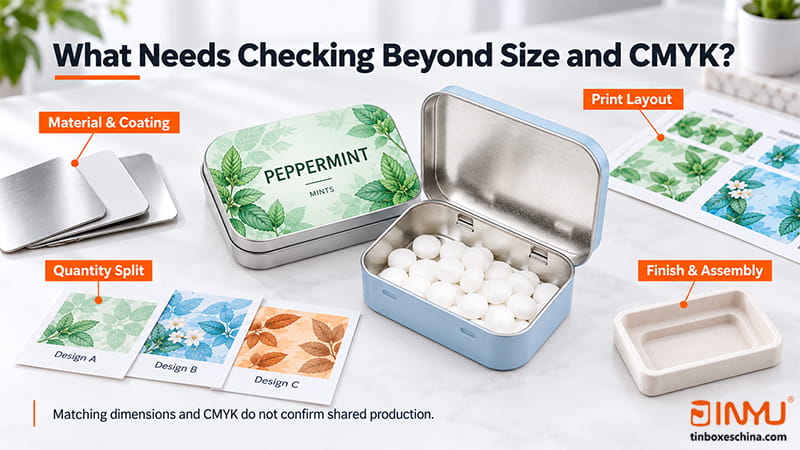
Do the materials and coatings work together? Matching dimensions does not prove the two designs are of the same material specification, internal coating, white base or surface finish.
Can the designs be laid out and printed? A combined layout must consider the dimensions of the components, the sheet format, the cutting requirements and quantities. Some designs may match up, others will need to be placed separately. That decision is not made with CMYK.
Is the quantity in accordance with the production plan? A small seasonal counterpart to a much larger core design warrants its own review. A common layout can relate to quantities produced, so the factory needs to consider how it will produce the requested mix without assuming the buyer will take unwanted stock.
And then what do you make of it? Special handling may be required for different embossing, inserts or packing instructions.
Ask the quotation to tell you the real shared work. Price is explained by “same tin” which is too general.
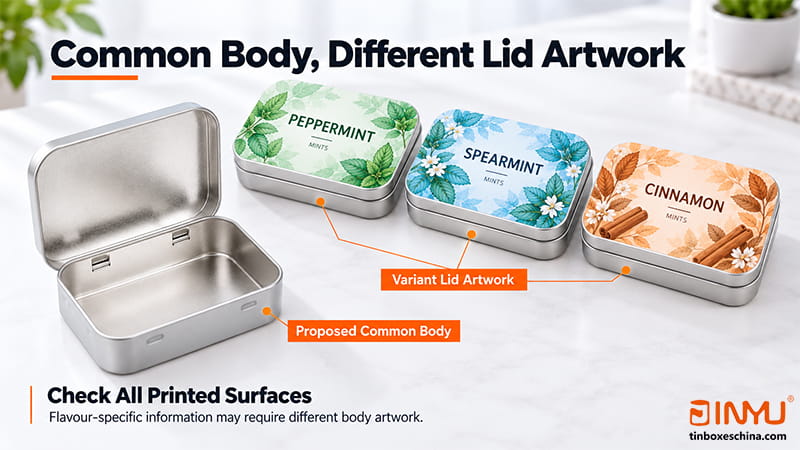
Begin with the specifications that are fixed. Where product fit permits, keep dimensions, lid construction, material and finish consistent. Keep the differences that customers have to see.
One possibility is a common body with different lids. Take a look at the print before you decide on it. If the body or base is printed with flavor-specific ingredients or a different barcode, then that part is not identical across the range.
For example, GS1’s GTIN Management Standard notes a new flavour added to a brand’s portfolio as an example of a new product that requires a new GTIN. [2] That’s for the retail product, not whether the empty tins are all from a mould. Then final product identification must still correlate correct artwork version. ref.gs1.org
another is to compare with or paper sleeves. Where appropriate variant information is carried on a common tin can as secondary decoration. Compare with additional materials, application work, appearance and durability. This is not an automatic way around MOQ. It is a different packaging arrangement.
Timing is key too. If multiple designs are to run together, set a deadline for approval of all of them. One unfinished barcode or late colour change can throw a wrench in that plan.
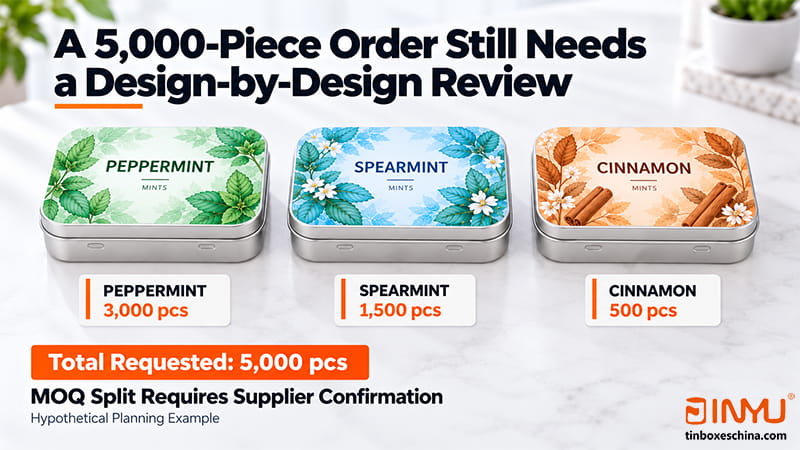
The example below is a hypothetical procurement example, not a completed Jinyu customer project, or approved MOQ split.
One rectangular hinged tin for three flavours is a mint brand. It wants a common body design and different lid for each flavour.
| Item: | Peppermint | Spearmint | Cinnamon |
| Finished tins requested | 3,000 | 1,500 | 500 |
| Size and Lid Design | Same | Same | Same |
| Lid artwork | A | B | C |
| Body artwork | Proposed common design | Proposed common design | Proposed common design |
| Full and Retail Information | To confirm | To confirm | To confirm |
Total: 5,000 cans. Whether that particular mix can be provided under the relevant production and commercial conditions is the unanswered question.
First, see if the body can really be common when the final product information is included. Next, review the three lid types and their quantities. Just because the other two take the order up to 5,000 does not mean that the 500 queue is covered.
The buyer can request a comparison of fully printed versions and, if possible, a common printed tin with flavour specific labels or sleeves. Or, start with fewer designs, but only if this fits into the brand’s sales plan.
Each possible option needs confirmed minimums, a price and a packing spec. If no one supports the requested split then the quantities or packaging approach must change. There is no approved savings to claim prior to those checks.
Let’s imagine a second hypothetical: Two tea blends have identical printed body, one has a plain lid, the other has an embossed lid. The body is still common. The requirements for the lid are different. By quoting the common component separately from the variant components, the decision is clearer than quoting one unexplained price for “assorted tins”.
A multi-design quote should be pretty cut and dry. Ask it to say:
Basis of quantity: finished quantity per design and the applicable MOQ.
Common components: which bodies, lids, or other parts are common to what.
Separate charges Artwork preparation, tooling, sampling or other quoted setup work.
Approval requirements: the files and samples to be approved for each version.
Quantity tolerances. Any agreed overrun or underrun and how it applies to individual designs.
Packing: separation of designs by carton, identification of cartons.
Remaining components: terms of ownership, payment and storage, if there is agreed stock holding.
Schedule: Approval dates, production arrangements, combined or split delivery?
And another question arises: what if only one flavour needs to be reordered?
A price based on producing three designs together may not be applicable to a subsequent order for one. There is no guarantee on quantity requirement, lead time or price on retained tooling or existing artwork. Check repeat-order basis before you rely on it in your launch budget.
Only if the supplier confirms the particular split. The order total combined is not the minimum for each version of an artwork or completed SKU.
No. The problem of the mould is the structure. Printing, finishing, components and packing are still to be evaluated.
This may be considered if the structure and the full body specification are identical. Treat the body as a generic one, check product information, component quantities and assembly controls.
“No. They bear their own costs for material, application and packing. Contrast the finished package and the quantity requirements confirmed.
Not by default. Manufacturing quantity requirements and goods consolidation are different questions.
For a useful review, please send tin size and lid type, number of versions of the artwork, quantity per version, shared components, finish requirements, inserts, packing instructions and delivery deadline. Note if you want to reorder designs separately.
For custom mint and gum tins please supply the artwork you wish to use or a clear description of how the artwork varies between flavours.
5,000 pcs is the Jinyu standard MOQ. A proposed split between designs must be reviewed and approved in writing. It is not automatically approved even if the total is 5,000. Send the breakdown so the quotation can identify the components and production steps that can be shared and the quantity requirements that apply.
Koenig & Bauer AG. A Very Special Kind Print Substrate November 12, 2021 Technical background on coating, printing, varnishing, drying and further processing of metal sheets.
GS1. GTIN Management Standard, Release 1.1, September 2023, Section 2.1, “Introducing a new product.” New flavours as example - requires new product identification.
These references support the process and product identification points noted above. They neither set the minimum order quantities (MOQs) to tin suppliers, nor decide if a given multi-design order is combinable.
Holen Sie sich die neuesten Informationen und Sonderangebote


 IPv6-Netzwerk unterstützt
 Deutsch
 English
 Français
 Español
 Português