
Every September we get emails that read something like this: “We need Christmas cookie tins. Can you get to Europe by the end of October?”
By then it’s already tight. If the project involves new tooling, three designs, transport testing and ocean freight to Rotterdam, a September start date makes a pre-Christmas launch nearly impossible. And if it doesn’t, the client loses not just a few weeks, but an entire selling season.
This article is about avoiding that email in September. It discusses how to plan a Christmas cookie tin project backward from your retail launch date, which stages take the most time, and where we have seen projects go off schedule.
Production time in our factory is only part of the journey. And often the choices made before production begins are more important.
A note before we get underway: If you’re reading this in September and you need tins by November, skip to the section on saving a late project. There are probably some options but they have trade-offs.
The first date to verify is not the 25th of December. This is the date your sales channel requires usable stock.
That date is different for each business. A supermarket supplier has to deliver to a distribution center weeks before the stock is on the shelves. E commerce seller needs time for product photography, barcode setup & fulfilment-centre booking. There may be no flexibility at all with a corporate gift program’s set event date.
Sometimes a delayed package of consumer goods can be absorbed into the next production run. A delayed Christmas tin that’s late to the party doesn’t fit on the shelf. It’s marked down. Or they sit in storage until the next season by which time the design is out of date and the cookies are past their best.
Set four dates before you contact us for a lead time.
These four dates make a vague Christmas inquiry a workable project. We can tell you our production lead time without them, but we can't tell you if your project is real.
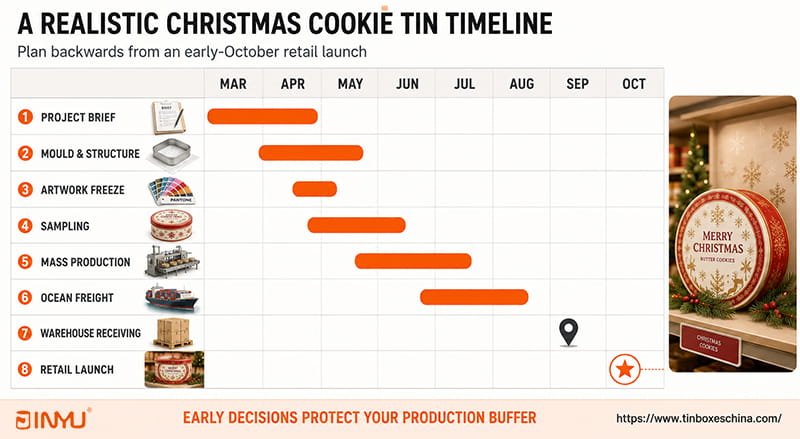
The table below shows a typical schedule for a brand planning a retail launch in Europe in early October. Assumes ocean freight and existing mold. But this gives a realistic frame. Your actual timeline may vary —
| Milestone | Example timing | What to do |
| Start project brief | March-April | Cookie specs, quantity, destination, launch date locked in |
| Mold matching and structure | Apr–May | Existing mold confirmed, pack-out tested with real cookies |
| Artwork development and freeze | May | Proofs, Pantone colors, embossing positions approved |
| Sampling (blank + printed + complete pack) | May-June | All three sample levels okayed |
| Mass production | June-July | Printing Assembly Inspection Export packing |
| Ocean freight | July-August | Shipments, documentation |
| Warehouse receiving | First week of September | Customs, inbound QC, labeling, allocation |
| Retail launch | October | Retail availability |
The point of this table is not that every order must begin in March. That’s because the retail launch is dependent on decisions made months in advance. “When clients tell us in July they need tins by October, we can sometimes do it – but the buffer is gone.
The fun part is the Christmas designs. Snowflakes, metallic gold, logos in relief, maybe a ribbon pattern. It’s tempting to start there.
But first things first, the cookie arrangement.
Confirm cookie dimensions, production tolerances, number of cookies per tin, layer arrangement, insert requirements and usable internal dimensions as applicable before any artwork is finalized.
We’ve learned that the hard way with a client who sent us their Christmas artwork first – beautiful snowflake design, gold Pantone, the works – but no cookie samples. We fitted them to a rectangular mold that we had that looked good. When the actual cookies were received for the pack-out test, they were 4 mm larger in width than the client’s original drawing. The tin would not hold 16 pieces. We had to move to a larger mold which meant we had to adjust the dieline, rework the artwork and move the sampling schedule back two weeks.
Should the cookie arrangement change at a later date, everything changes: the tin size, the insert, the dieline, the artwork, the export carton, the pallet count and the freight calculation. Pack it out right first, then make it beautiful.
The mold decision impacts the entire critical path.
The use of a pre-existing mold does not require a lot of structural development work. We can quickly get the dimensions confirmed and move to sampling. And we have more than 3000 existing molds in Jinyu, so mold matching is always the first step for seasonal projects. But you have to test an existing mold with your own cookies, insert and inner bag. It is only “approved for production” after the pack-out works.
New tooling adds weeks. Structural drawings, tooling development, trial forming, lid and body fit checks, possible adjustments, and new structural sampling. So for a simple change, like changing the height of an existing body, the extra time is maybe two to three weeks. For a new odd shape, it might be six weeks to eight weeks, or even more.
What is important is this: If you need new tooling, decide that at the start of the project. We've had clients say "let's use an existing mold" and then spend three weeks on artwork for that mold, and then realize they need a custom size anyway. By then the tooling delay + artwork rework means the timeline is broken.
Decide first the mold. Then you build the artwork around that.
One of the biggest scheduling mistakes is to consider only factory days.
We can make drawings, make samples, make production schedule. We cannot approve your artwork, get sign-off from your legal department, or choose between conflicting comments from three of your team members.
A project from last year is a prime example of this. In 8 days we created a blank structural sample and couriered it to the client. The factory work was finished. It took the client’s internal approval team three weeks to approve the design. Brand, legal and procurement all had to sign off and each department made a request for a change. It was four weeks after we sent the first sample and the printed sample was approved. One production batch was air-freighted at the client’s expense to meet the retail deadline.
Eight days of domination in the factory. The buyer had twenty-one under his belt.
If you are building a timeline, remember that buyer approval is a production stage that consumes time. Select one individual to gather the comments and give final approval. One name next to ‘approved’ and a project moves much faster.
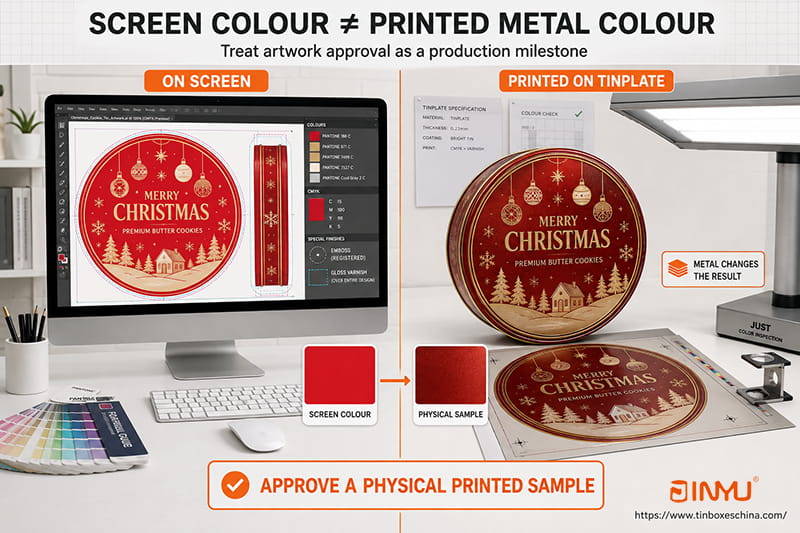
Artwork is not a final detail that can be left open until the production line is ready.
The final file should confirm dieline, CMYK and Pantone specifications, metallic areas, varnish requirements, embossing locations, inside-lid printing, barcodes, product information, importer details and correct version for each SKU.
The colors on the screen don't translate well to metal. Colors approved on screen changed appreciably when printed on tin plate. If brand color is critical, the approval route should be agreed before sampling – and must include a physical printed sample.
Set an art freeze date. If there is any change after that date, we will review the sample schedule, production capacity and launch timeline. We’re not saying there aren’t changes to be made. We are saying that they have a cost and that cost is often measured in missed shipping windows.
Using the same mold for three Christmas designs means less structural work, but it does not mean that three designs are one production item.
Each SKU still needs to have its own file checking, color approval, printing setup, verification of the barcode, identification of the carton and allocation of the quantity. Late design addition can look like a little commercial change. This means more artwork, more press time, more labels and more warehouse complexity in production terms.
Please confirm the final number of designs and quantity per design before sampling. We can't just start production on the approved design and "add" the other one later without impacting scheduling. If we have one design approved and one still in review we can't do that.
'We've had clients ask, "Can you just print an extra 2,000 of the snowman design while we finalize the reindeer artwork?" Sometimes we can slot it in. Sometimes we can’t. The production line is already booked. Assume all designs must be ready at the same time and plan accordingly.
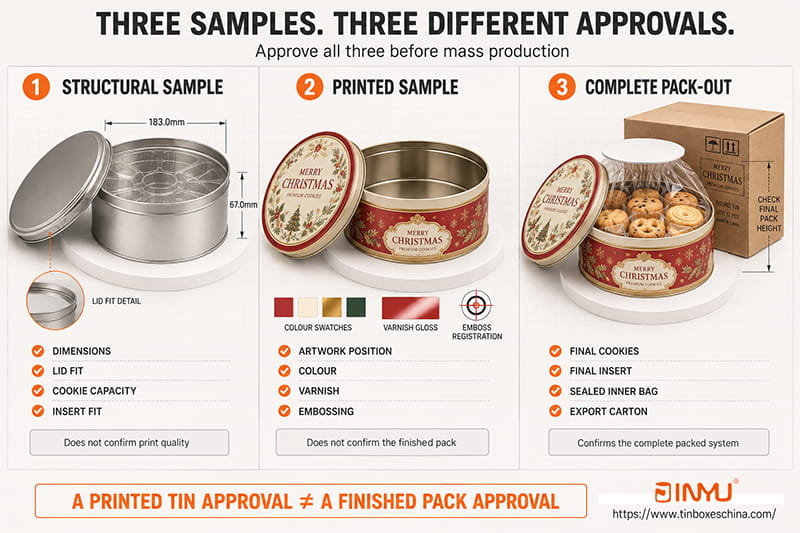
“Sample approved” can mean three different things, and they all matter.
The structural sample tests dimensions, lid fit, cookie capacity and insert fit. It does not guaranty print quality. Usually blank or with little printing on it.
The printed sample checks artwork position, color, varnish, metallic effects and embossing registration. It might be empty, so it cannot confirm the full cookie pack.
The full pack-out sample consists of production equivalent cookies, the final insert, the sealed inner bag and the intended export carton. "This is the one that tells you whether the whole system works.
We always recommend approving all three before mass production release. One client approved their printed sample – gorgeous, right Pantone, everything looked right – but missed the total pack-out. The filled tins crushed the top layer of cookies because the sealed bag added 5 mm of height they hadn't accounted for. The tin was okay. The print was good. The cookies were all broken.
Approval of a printed tin is not approval of a finished cookie pack.
For confirmed project of custom printed cookie tin, our mass production lead time is normally 25-35 days after final approval.
Final approval means everything is locked: tin structure, dimensions, artwork, colors, embossing, quantities, insert specifications, export packing and commercial terms.
Production includes tinplate preparation, printing and coating, sheet cutting, component forming, assembly, inspection, individual protection, master-carton packing and preparation for shipment.
25-35 days does not include artwork approval, sample revision, freight booking & shipping time. It begins when the file is completed and the order is released. If you are still changing colors at the start of production, then the 25-35 days haven’t really started yet.
We have gone into detail in our quotation guide for a more thorough examination of what impacts cost and lead time.
The project does not end when the last tin rolls off the production line.
To be continued: final inspection, insertion and packing of accessories, sealing of cartons, palletizing, packing lists and commercial documents, loading onto container, handing over to freight forwarder, awaiting confirmed departure.
The freight planning should be done before production is finished. We’ve had clients wait until their tins were stacked on pallets to book their shipping, only to find that space on the vessel was limited, or the freight forwarder wanted documents they hadn’t prepared, or the port was congested.
In mass production, you should already be checking destination port, delivery address, full-container or LCL, cargo volume and weight, pallet requirements, documentation, customs info and receiving procedures.
The port-to-port transit estimate provided by your forwarder is not a delivery promise. Port waiting time, transshipment, customs clearance, inspection, terminal release and inland delivery add days, sometimes weeks.
And remember: the demands of the holiday season strain logistics and production. Freight networks get busier and the cost of delay grows every day. We advise our clients to book earlier than they think they need to, because a week of buffer is a lot cheaper than a week of air freight.
A lot of Christmas packaging projects go from production to export shipping in the second half of the year. That would coincide with China's National Day holiday in early October.
Don’t assume normal working schedules will go on uninterrupted with the exact holiday arrangement changes each year. If you’re still waiting at the end of September for your project’s artwork approval, the risk isn’t just a few days of lost production. It could also impact the availability of production slots, inspection arrangements, trucking, freight booking and document preparation.
This is not something we see as a reason to panic every year. With a little planning most years the holidays are manageable. But if the whole timeline is contingent on all of the stages going perfectly through early October, that’s a fragile plan.
Ask us about the holiday schedule for your specific year when you’re building your timeline. It's an easy thing to check, and can save you from a nasty surprise.
A good schedule doesn’t add all stages end to end. Some work can be performed simultaneously.
The key question we always ask: “What can you work on right now that doesn’t depend on the next approval?” The answer is usually more than clients expect.
Yes, sometimes, but every shortcut has costs.
Possible options are:
Air freight can reduce timing for international transport but metal tins are bulky for their value. The charge is based on the actual packed dimensions and chargeable weight, not the net product weight.
And here’s the reality check: Air freight can’t make up lost time because the tin structure is still up in the air, the cookies don’t fit, or the artwork hasn’t been approved. These problems exist regardless of the speed of the cargo.
There have been rush projects where we had eight weeks to do the whole thing. It worked — but the client paid a premium, had no time for sample revisions, and took on more risk. We do not recommend this unless there is no alternative.
"No definitive answer to 'How fast can the tins be made?' until the structure, design, destination and approval path are in place.
For a practical timeline review include:
The more of these you can give us, the sooner we can tell you if your timeline is going to work. Even if you don't know all of it, we can still help you, but the first estimate will be wider to cover unknowns.
When planning a Christmas cookie tin project, plan backward from the shelf, not forwards from the factory.
The idea is not to get the tin out fast. The aim is to have the right product in the right warehouse early enough to be inspected, allocated and launched into retail.
First, the cookies. Mold and insert verification. Freeze the art work. Three levels of sample approval shall be provided. Book freight before production is finished. And put the biggest buffers on the stages with the most uncertainty — which, in our experience, tend to be the buyer’s internal approval processes, not the shop floor.
If you are working on a Christmas cookie tin project, please include your retail launch date, destination, quantity, number of designs, cookie size, preferred tin structure and shipping method. We will review our existing mold library of over 3,000 shapes and sizes and plot the development, sampling, production and export-packing milestones for your project. You’ll have a realistic timeline in 48 hours.
Custom printed cookie tin projects are usually minimum 5,000 pieces per design and size. Sample development is approximately 7-10 days. Following final approval, then, mass production takes 25–35 days.
Fix your retail launch and warehouse ready dates first, then work backward. The majority of projects need to start in March or April for ocean freight to reach stores in early-November in Europe or North America. New tooling. Multiple designs. Complex inserts. Time consuming.
Sample development usually takes 7-10 days after structure and specifications are confirmed. To this you should add the delivery by courier, your internal review and any revision cycle.
"Usually, yeah. It eliminates the new-tooling phase. But the existing tin still needs approval with your actual cookies, insert and inner bag.
Nope. 25-35days start from the final approval of the sample, artwork, quantity and packing method. That clock doesn’t begin ticking until artwork is created and approved.
Each design requires its own artwork control, printing preparation and allocation of quantities even if they share the same tin structure, insert and carton. Design to confirm quantity before sampling.
Start freight planning before production is complete. Your forwarder will need to know the expected cargo-ready date, carton dimensions, gross weight, volume and destination. Don't wait for the tins to be on pallets.
It may cut transportation, but it cannot cut unresolved design, sampling or approval work. Tins are bulky so air freight is expensive - work out the chargeable weight before planning on it as a recovery plan.
Not so sure. Some stages can be shorter if the structure, artwork, insert and packing method are kept unchanged. Any change – cookie size, design, compliance text, insert, carton, destination – brings a new round of approvals and testing.
The shipping plan and the available production slot have to be checked. Do not assume that the original completion date will not change to accommodate for late approval.

Holen Sie sich die neuesten Informationen und Sonderangebote


 IPv6-Netzwerk unterstützt
 Deutsch
 English
 Français
 Español
 Português