
The printed coffee tin can be a sealed retail pouch, a refillable storage container or part of a factory sealed packaging system. Those roles put different stresses on the lid, seams, internal coating and filling operation.
The choice of coffee tin packaging begins with the coffee and the way it will be packed. Whole beans and ground coffee require different assessments but can share an outer tin when the capacity, internal components and sealing arrangement are suitable for both.
This guide deals with tinplate packaging of dry roasted whole beans and ground coffee. Coffee mixtures, instant coffee and liquid coffee products need their own packaging briefs.
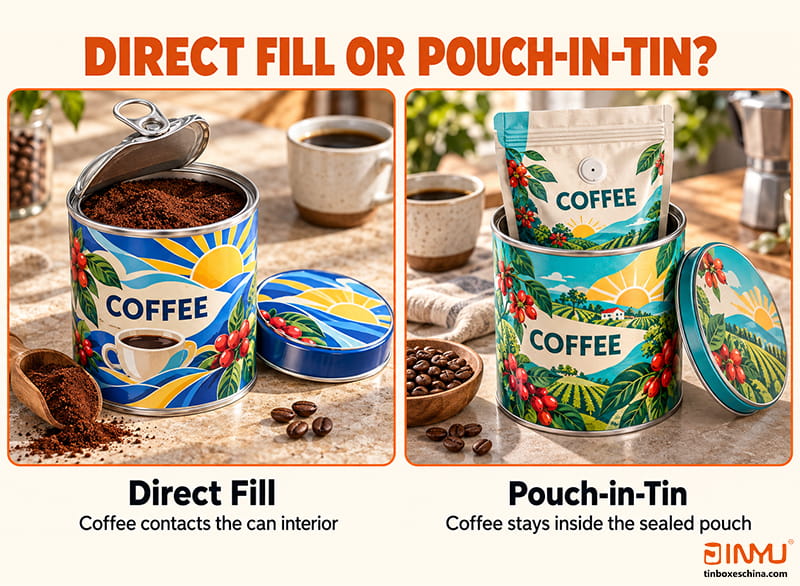
Before you compare lid styles, decide what component will protect the coffee during distribution.
Direct-fill packaging: coffee contacts inside surfaces of the can. The packaging specification should include the can body, the seams, the closure, the coating and any valve or membrane.
A sealed pouch within a tin: the pouch provides the necessary product contact and barrier system. The outer tin gives a rigid case with printable surfaces and the agreed protection all around it.
An empty reusable coffee tin: customers fill or restock the container themselves. The product brief becomes a part of instructions, access for opening, reclosure and maintenance.
The finished size of the coffee bag can start a gift tin with it. When filling retail cans directly, the sealing and filling process must be evaluated from the start.
And specify the intended trip: local sales, subscription delivery, expanded retail distribution, export or foodservice Indicate the expected period of use after opening.
Roasting coffee releases gases including carbon dioxide. Grinding alters the structure of the bean and how those gases escape.
Smrke and colleagues studied coffee degassing, measuring gas release from whole beans and ground coffee under different roasting conditions. It allows you to judge the actual roast and pack process, rather than applying a single waiting period to all coffees.
| Input specification | entire bean coffee | Ground coffee. | Procurement impact |
| Condition of the product | Roast profile and time after roasting | Roast profile, roast range and time since roast | Write down the state of the coffee when it hits the filling line |
| Volume occupied | Dimensions and packing arrangement of beans | Filling and settling method and particle size | Build Capacity with Representative Filling |
| Gas handling | Continued release after roasts | Gas release during grinding and further processing | Select process and components together |
| Contact filling | Beans can enter the closed area | Fine particles can deposit on sealing surfaces | Watch the real filling and closing sequence |
| Access for consumers | Scooping or pouring beans | Scooping powder and handling residue | Check opening, access to scoop and re-closure |
| Changes in Range | Different beans Different roast profiles | Different blends or grinds | – Re-evaluate affected functions before continuing with the same specification |
The full package is not defined by either of the product names. A whole bean project still needs oxygen and moisture protection relative to its freshness target. Ground coffee project still needs gas release assessment.
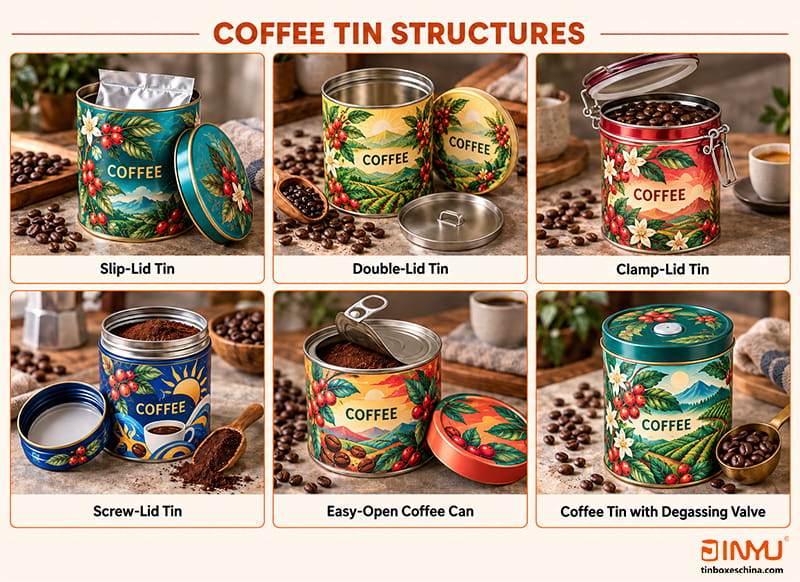
Separate the body build-up, the opening action and the first seal. The same package can be a screw closure and a degassing valve. A round can.
The combinations below are starting points for sample development .
| Configuration | Assessment applications | Practical benefit | Main limitation or check: |
| Common slip-lid tin | Sealed coffee bags, gift packs, reusable outer containers | Easy to open Wide decoration options | Airtightness cannot be achieved with friction fit alone |
| Outer lid with an inner lid or plug | Coffee storage and pouching projects | Open sequence and internal cover separated | Inner-cover construction, fitting, removal and powder residue |
| Clip or clamp lid with gasket | Selected direct-fill projects Refillable coffee containers | Mechanical retention with defined gasket interface | Gasket compression, alignment, reuse & gas management |
| Screw cap with specified liner or gasket | Projects Requiring Reclosure in the Rotation | Controlled engagement of the cap with the neck | Thread fit, closing torque, liner condition, and trapped lands |
| Factory-sealed can with easy-open end or peelable membrane | Retail Coffee Packed Directly | a first-open seal defined | Compatible body, end, equipment and sealing process. |
| Sealed build with degassing valve compatible | Coffee that’s packing and needs to off-gas | A path designed to release internal gas | Valve performance, installation interface and integrity of the complete pack. |
A hinged gift box can also hold a pouch or individually sealed portions of coffee. The attached lid is an access feature. Its inner pack has its own specification.
A slip lid goes over the outside of the body and lifts right off. This is a practical option where an approved inner bag provides the required barrier.
Check retention, overlap and clearance over filled pouch of the lid. The coffee will probably fit inside but a folded bag seal can get caught under the lid.
Evaluate the tin with intended retail and shipping protection for parcel delivery.
The term double lid coffee tin can mean different things. An inner cover may fit loosely within the opening or engage a formed seat. Ask for a section drawing or a physical sample.
Check both lids with the pack filled in. Check how the inner cover is removed, where it is placed during use, and whether grounds accumulate around its seat.
Two covers, two elements to evaluate. The number does not constitute a shelf-life claim.
A clamp or clip provides mechanical retention and the gasket contacts the sealing surface.
material, size and location of gasket. Indicate Verify even seating around the opening, alignment of the lid and effort required to operate the mechanism. Repeat assessment after agreed opening cycles
Ensure gas management is part of the brief for fresh-packed coffee. But a firm latch does not explain how pressure will be handled.
The closure is a screw closure engaging the neck of the container by rotation. Its sealing performance is based on the complete closure of the device including any liner or gasket.
For ground coffee, check the threads and sealing face after realistically scooping or pouring. Make sure the cap closes evenly and the user can tell when it is fully engaged vs. not fully closed.
The actual materials are: A coffee container or lid that looks like metal might be made from aluminium, stainless steel or plastic, rather than tinplate.
The easy-open metal end and the flexible peelable membrane are provided with different opening mechanisms. specify which one to use, and add the separate overcap if customers want multiple access.
Check the whole container, including the bottom and side seam. The end and body must be properly formed together in a double seamed construction. Crown’s seaming guidance encompasses the two seaming operations as well as the function of the gasket material in the seam.
Agree which end is already fitted, where the filling will take place and who will do the final seal. You can’t ask for a different lid and make a decorative tin into a factory-sealed coffee can.
A coffee tin with degassing valve needs a matching container, seal arrangement, and installation method.
Wipf carries out tests on flow, opening pressure and sealing after installation. It explains the operating principle of its aroma-protection valves WICOVALVE. The procurement lesson is to evaluate the installed component in addition to the valve specification.
| Packaging method | What it is about | What is still to be assessed |
| One way degassing valve | gas evolution in the package | Product contact Other leakage paths and valve selection Installation |
| Nitrogen flushing | Oxygen reduction in the atmosphere of the package at the time of packing | Process consistency Residual oxygen Downstream gas release and seal performance |
| Vacuum packaging | Gas removal during a defined packing operation | Retained vacuum, gas release and container suitability |
| Pressurised packaging | A defined internal gas pressure | Strength of the container, sealing system and controlled procedure of packing |
These may be parts of a packaging system, but they are not interchangeably describing the same thing.
For example, illy’s official explanation of pressurised preservation states that the air in the tin is replaced by inert gas at a pressure above atmospheric pressure. This is a defined process and not a property that is derived from the appearance of a tin.
Check the whole gas path if you have a valve pouch inside a tin. The valve shall be free of folds, wall and lid pressure. Also consider the movement of the released gas from the outer container to the environment, especially if the outer closure restricts air flow.
This is a full pack engineering check. An unblocked pouch valve alone does not validate the outer tin configuration.
More component considerations are discussed in Jinyu’s guide to degassing valves on coffee tins.
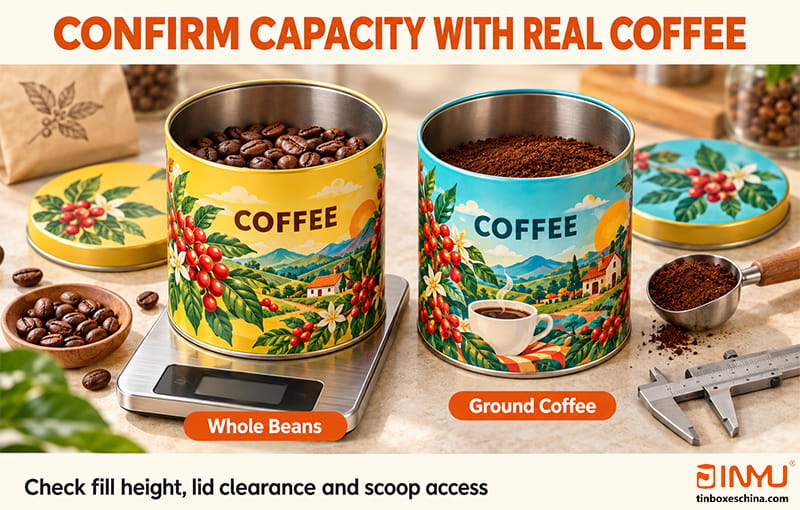
A nominal 250 g coffee tin is not a full description. Verify that capacity . Work out what coffee , filling method and internals were used .
External dimensions assist in planning shelving and cartons. Coffee fills the utilisable cavity, once rolled edges, shoulders, lid intrusion and packaging components are factored in.
| Detail to measure | Why this matters |
| Target net weight and representative coffee lot | Establishes that the actual fill is approved. |
| Volume after filling (after filling) | Indicates if load and close are possible |
| Settling in the agreed handling sequence | Changes in presentation and space available |
| Clearance under the closure | Keeps coffee and packaging clear of moving/sealing surfaces |
| dimensions of filled bag | Includes seals, zipper, valve, folds and gusset |
| Instruction card or ladle | Adds requirement for accessory/removal |
| Scroll to the bottom | Verifies that the rest of the coffee can be easily taken out |
For loose coffee, an initial volume can be estimated from the measured bulk density, volume = mass ÷ bulk density. Check the size proposed, by filling in the actual sample. Measure how density was measured.
The headspace must be appropriate for the process and intended use. It does not replace gas management strategy to increase it. If it is reduced too much it may interfere with sealing or access.
A roaster making both whole bean and ground of the same weight can try both in one candidate outer tin. If a configuration requires forced folds, has lost scoop access or blocks the closure, change the internal arrangement or choose a different size.
Each of these channels requires a different handling and presentation of the same coffee.
| Program | Package direction assessment | Development priority |
| Coffee retail | sealed can or specified pouch in tin | Protection, first opening and information required, not opened |
| Online delivery or subscription | Tin with specific internal packaging and protection for transport | Pouch wear, scuffing, closure retention and condition of arrival. |
| Gift collection ( | Sealed coffee or portion packs Printed tin | Full content layout, presentation and clear component scope |
| Refill Program | Retained tin with compatible refills | Dimensions included refills access and repeat-use instructions |
| Use in food service/roastery | Larger container with appropriate handling and closure | Loading, repeated access and gas management, pouring. |
A documented example of a larger format is the 12 litre tinplate coffee roasting pail by Dosenprofi. Its components include: venting arrangement, latch ring and transport safety fitting.
That’s an example of how a coffee app can work out a particular set of components. Its dimensions and instructions for use are part of this product and should not be transferred to a small retail tin.
For seasonal blends, consider if a common outer design with a variant label or sleeve could cover the range. Check label adhesion, abrasion and access to essential information on the finished pack.
Factory seal and cover used afterward do different jobs.
| Package state | The key question | Practical test |
| Unopened after filling. | Does the pack maintain the coffee in the stated condition? | Sealing records, integrity testing and storage evaluation |
| First published | Can the consumer open it cleanly and get to the coffee? | Opening action Edge condition Product disturbance Removed components |
| Recloses while in use. | What about repeated access ? Does the proposed cover work well ? | Fit, powder residue, gasket condition and agreed use simulation |
Ground coffee tin packaging: Check residue after real user routine. An inner-plug seat, gasket, thread or membrane sealing area may still be grounded. Evaluate impact on closure and maintenance.
For whole beans, check if beans are caught at the rim when pouring or scooping back.
Anese, Manzocco and Nicoli studied the secondary shelf life of ground roasted coffee and examined the quality during simulated household use by repeated opening and closing. It encourages separate evaluation of use after opening. The study conditions do not require a single consumption period.
Different instructions are also required for replacement bags and for direct refilling. Replacement pouch must fit when full. Direct refilling requires an appropriate contact surface and a maintenance schedule that ensures the container is thoroughly dry before it is used again.
tinplate steel coated with tin The specification should describe the material and construction and not use the term “metal coffee can.”
Ask about how the side seam, bottom and top are made. The sealing system proposed must be analysed in terms of the construction details of a welded, mechanically joined or drawn body. Visible rolled edges do not alone determine gas tightness.
List all parts that may come in contact with coffee.
Exposed metal and internal coating.
Liner/inner bag.
Membrane contact layer, sealing compound, and gasket.
Material of attachment and valve.
Scoop or other accessory included.
Request information on material suitable for the intended coffee, its contact conditions and sales market. Check the sample as a whole for coating continuity, loose particles, sharp edges and discernible packaging odour.
Thickness appropriate to size, for considerations of detail and handling. An improper closure or incomplete seal will not be remedied by a thicker body.
Store and handle approved tin and its components in a dry condition. Maintenance instructions should be consistent with the actual coating and construction.
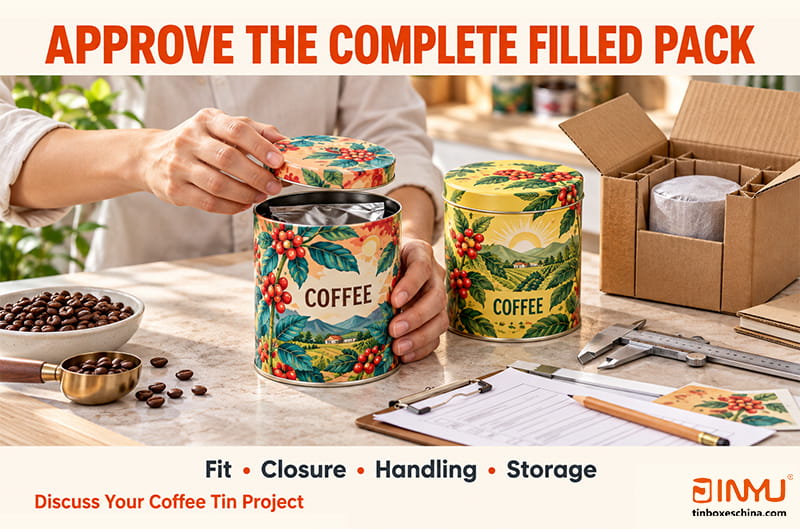
The most useful sample is the one that represents the proposed coffee, tin, internal components and packing sequence.
Agree methods, quantities of samples, conditions and acceptance criteria prior to approval.
| Review | What to do? | What to use tape on |
| Capacity and loading | Fill to target weight of intended method | Coffee batch, fullness, height, and loading problems |
| Closure operator | Close and re-open filled package | Interference, Trapped Content, Alignment, and Retention |
| Seal surface cleanliness | Check immediately after filling | threads and gaskets or valve areas on membrane lands rims |
| parts for gas management | Evaluate the installed layout | Installation conditions and corresponding functional results of component model |
| Oxygen control where specified | Assess the agreed conditions for filling and packaging | Measurement method, time, conditions and results |
| Distributions | Inspect the loaded package with its shipping protection | Opening, dent, abrasion, pouch damage and functional change |
| Storage and multiple uses | Assess unopened and use-simulation groups independently | Conditions, hours of opening, sensory and other agreed indicators |
Use the observations in the unopened-storage and destructive tests from independent samples. Repeated opening of one sample changes the condition being studied.
Separate three types of evidence:
Material barrier information. For an internal pouch obtain the oxygen and water-vapour transmission data for the construction, units and test conditions. ASTM D3985 is on oxygen transmission rate of plastic film and sheeting.
Overall package performance. Evaluate the seams, closure, valve and other interfaces by appropriate methods. ASTM F1307 is used to measure the oxygen transmission rate of packages that are meant to hold a dry environment. The suitability for the proposed construction should be affirmed by a laboratory.
Coffee quality in storage. Establishing the supported freshness claim using the agreed sensory and other quality criteria of the coffee owner.
A pack that does not release visible grounds during handling may still need to be assessed separately for oxygen ingress. An aroma comparison doesn’t prove closure integrity either.
Keep approved drawings, component specifications and sample identity. Review affected functions when coffee, coating, gasket, pouch, valve or filling process change.
Request for costs for full supply scope: body, lids, inner components, valves, membranes, decoration, tooling, assembly and transit protection. Separate minimums for specialist components.
One part of the development can be saved by using an existing outer mould, but a new lid, gasket or pouch still has to be developed. In addition, factory-sealed projects might need filling-line tooling or equipment changes.
| Information to be provided | Details of supplier needs |
| Profile of coffee | Whole Bean or Ground Coffee Roasting and Grinding |
| Packing times | Normal interval between roasting/grinding and final sealing |
| Role in Packaging | Direct fill, pouch sealed in a tin or empty reusable container |
| Target capacity | Net weight, representative samples, and fill method intended |
| The preferred building | Shape, lid operation, body and first seal requirements |
| Gas and oxygen handling | Process intended, available equipment and components |
| Use within opened | Pouring, Scoop, Refill and Predicted Access Pattern |
| Distribution and market | Destination, retail or online route, storage and transport summary |
| Decorating and | Artwork, alternative strategy, labels and marking areas. |
| Order Schedule | Repeat order and delivery schedule, quantity per size and design |
Delegate the procurement, installation, filling, final sealing and verification of components. The empty-tin supplier and coffee packer need a common specification for the operations each controls.
Approve appearance using agreed colour proof & production intent sample. Don’t place required information in areas of lid overlap, curved edges and removable parts.
Yes, each filled configuration meets its capacity, sealing and use requirements. Sharing the outer tin does not mean that all the other parts or fillings must be the same.
The name is a set of covers. For the specific body, lids and interfaces airtightness evidence is required. Check inner plug fit, gaskets where used and the whole package.
The choice depends on the coffee at packing, next release of gas and whole packing process. Ground coffee needs to be assessed as well. Where the valve is to be located and how it is to be installed, if necessary.
Nitrogen flushing takes care of the atmosphere when packing. Whether the sealed pack requires a gas-release route is a separate decision of the process.
It's evaluable. Check filled dimensions, valve clearance, pouch wear and gas path through outer container.
It is contingent upon the coffee, the filling process, the complete packaging system, the storage conditions and the use after opening. Do a proper filled pack study to establish the claim.
Smrke, S., et al. (2018). Time-Resolved Gravimetric Method To Assess Degassing of Roasted Coffee. Journal of Agricultural and Food Chemistry, 66(21), 5293–5300. DOI: 10.1021/acs.jafc.7b03310.
Anese, M., Manzocco, L., and Nicoli, M. C. (2006). Modeling the Secondary Shelf Life of Ground Roasted Coffee. Journal of Agricultural and Food Chemistry, 54(15), 5571–5576. DOI: 10.1021/jf060204k.
Crown Holdings. Seaming. Double-seam formation and the role of gasket material.
Wipf AG. WICOVALVE. Valve operation and evaluation of installed valves.
illy Hong Kong. Quality — Pressurised Preservation. Official description of illy’s preservation process.
Dosenprofi. 12-Litre Coffee Roasting Pail with Vent Hole and Lid Embossing. Documented tinplate container and component arrangement.
ASTM International. ASTM D3985-24. Oxygen transmission rate testing for plastic film and sheeting.
ASTM International. ASTM F1307-20. Oxygen transmission rate testing for dry packages.

Holen Sie sich die neuesten Informationen und Sonderangebote


 IPv6-Netzwerk unterstützt
 Deutsch
 English
 Français
 Español
 Português