
 Deutsch
 English
 Français
 Español
 Português
In high-end gift packaging, the real comparison is no longer simply between luxury appearance and lower cost. It is between packaging that performs once and packaging that continues to protect the product, support the brand, and stay useful after the first opening. That is why more premium gift programs are shifting from paper boxes to hinged lid tins.
Many premium gift projects still begin with paper packaging because it samples beautifully. Surface print looks refined, structure development is fast, and initial unit cost appears efficient. But once the order moves into long-distance transport, warehousing, stacking, and repeated handling, paper often reaches its performance limit much sooner than expected.
Hinged lid tin box are replacing paper boxes not because they look more premium in a catalog, but because they reduce failure risk across the full packaging lifecycle. For sourcing teams, that makes the decision less about appearance alone and more about reliability, brand retention, and total value after delivery.
Quick Answer
- Hinged lid tins combine a rigid metal body with an attached cover, supporting product protection, repeated opening and reuse in premium gift packaging.
- The attached lid reduces the risk of losing the cover, while later use as a keepsake or storage box can extend brand visibility.
- Rigid tinplate can resist compression and retain shape during handling, but transport performance still depends on thickness, forming quality and export packing.
- Tea, chocolate and cosmetic gift tins can combine printed artwork, embossing and selective finishes with a structure suited to their contents.
- Paper gift boxes often offer lower initial costs and suit short-run or budget-sensitive projects; tins become relevant when durability and continued use justify additional expense.
- For Jinyu projects, compare total delivered cost and expected reuse, then approve samples for hinge stability, lid fit, finish durability and protective packing.
Where the Shift Really Starts: Performance After Sampling
One of the clearest patterns in premium gift packaging is that paper often performs best at the sample stage, while hinged tins prove their value after scale begins. Crushed corners, surface abrasion, compression marks, and humidity-related wear may not destroy the packed product, but they can weaken the premium impression that the outer packaging was meant to create.
Hinged lid tins behave differently. Once hinge tolerance, lid fit, material thickness, and structure are properly confirmed, their performance becomes more predictable in production, transport, and end use. That predictability matters for brands shipping premium tea, confectionery, wellness kits, cosmetics, or seasonal gifting programs where packaging damage is not just a logistics issue but a branding loss.
| Evaluation Dimension | Hinged Lid Tins | Paper Gift Boxes |
|---|---|---|
| Structural strength | Higher resistance to impact, stacking pressure, and deformation | More sensitive to compression, corner crush, and handling wear |
| Moisture and surface stability | More stable in changing warehouse and transport conditions | More vulnerable to humidity, scuffing, and visible aging |
| After-shipping appearance | Usually stays closer to approved sample condition | Can vary more visibly after shipment and handling |
| Reusability | High, often kept for storage, gifting, or refill use | Usually limited after first use |
| Brand lifespan | Longer, because the package often remains visible after purchase | Shorter, because the package is more often discarded |
Why Hinged Lid Structure Changes the User Experience
The hinge itself is not a minor detail. It changes the way users interact with the package. Unlike separate-lid formats, a hinged lid stays attached, reduces the risk of lid loss, improves opening convenience, and creates a more complete feeling of product control.
In gift packaging, that matters because the consumer remembers not just the outside look, but also the first opening moment. Paper boxes often deliver one strong first impression and then begin to wear. Hinged tins, by contrast, can continue to feel intentional and functional long after the original contents are gone.
Beyond Paper and Plastic: Why Brands Are Making a Broader Shift
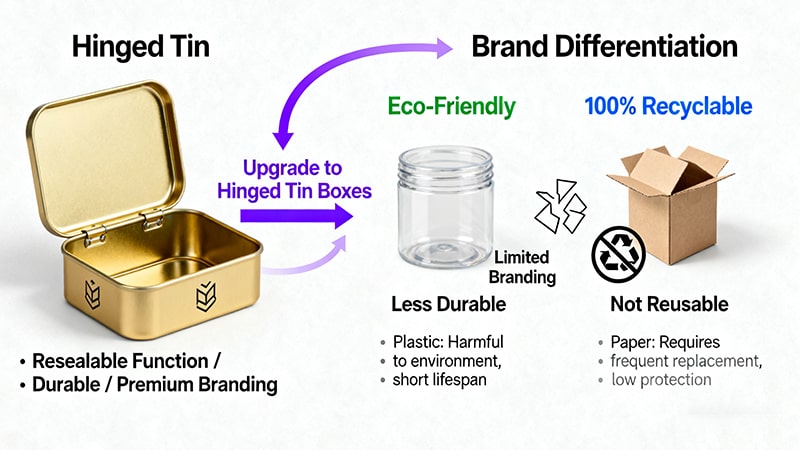
The shift is not only from paper to metal, but also from short-life packaging in general toward more durable, reusable formats. Hinged tins are increasingly positioned as an alternative to plastic-heavy gift formats and disposable presentation boxes because they combine protection, premium appearance, and sustainability messaging in one format.
That said, the strongest sustainability argument is not simply that tinplate is recyclable. It is that hinged tins often remain useful. A pack that becomes a keepsake box, desk organizer, refill container, or travel storage case creates much longer brand visibility than a paper box that is discarded shortly after opening.
Where Hinged Lid Tins Work Especially Well in Premium Packaging
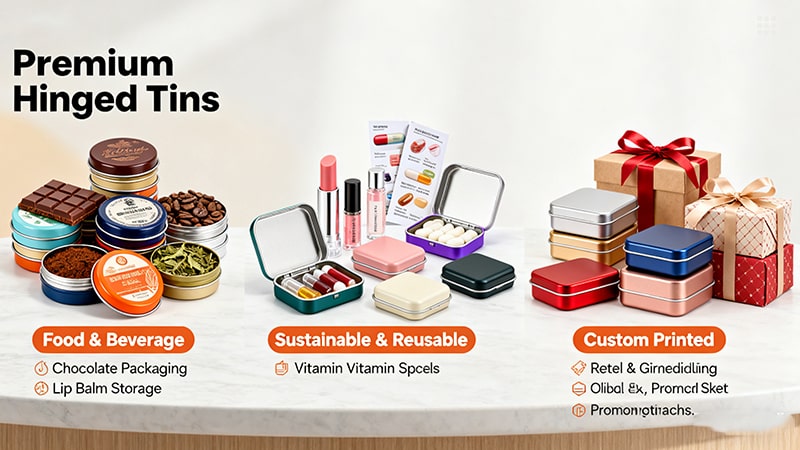
Hinged tins are no longer confined to mints or basic confectionery. Their cross-category suitability helps explain why more gift buyers are willing to standardize on them across premium packaging programs.
- Food and beverage gifts: chocolates, tea samplers, coffee gifts, biscuits, and confectionery sets benefit from stronger protection and more premium presentation.
- Beauty and wellness: lip balm, solid perfume, lotion bars, supplements, and self-care gift kits use hinged tins to replace weaker secondary packaging and reduce plastic dependence.
- Stationery, keepsakes, and promotional gifts: branded keepsake sets, collectible items, and desk accessories gain both protection and after-use value.
- Holiday and limited-edition launches: hinged tins are especially effective where repeat gifting, display value, and seasonal reuse matter.
Cost Looks Different When Lifecycle Value Is Included
Paper usually wins on initial unit cost, while hinged tins often win on damage control and long-term value. Even when metal packaging costs more upfront, brands may recover that difference through lower replacement risk, stronger reuse, higher giftability, and better repeat visibility.
| Commercial Factor | Hinged Lid Tins | Paper Boxes |
|---|---|---|
| Initial unit cost | Usually higher | Usually lower |
| Damage-related risk | Lower once structure is confirmed | More easily underestimated in large shipments |
| Brand memory after purchase | Stronger because packs are often kept and reused | Shorter because the packaging has less post-use life |
| Gift-readiness | High, with stronger premium feel and display value | Can look premium, but wear and collapse risk are higher |
| Long-term value | Often stronger when reuse and visibility are considered | More limited beyond the first presentation moment |
What Still Makes Paper the Right Choice Sometimes
This is not a case of metal always beating paper. For short-run promotions, highly cost-sensitive items, or projects where outer-box longevity does not matter, paper can still be the right solution. The problem is not using paper. The problem is using it by default on premium gift programs that demand strong shipping resilience, durable presentation, and after-use brand value.
Why the Trend Continues to Grow
Hinged lid tins continue to gain attention because durability, premium branding, and sustainability are converging in one format. As more brands seek packaging that performs well in shipping, looks stronger on shelf, and remains useful after purchase, hinged tins become a more natural choice for premium gifting.
What Buyers Should Care About in a Hinged Gift Tin
In real projects, the difference between an ordinary hinged tin and a high-performing premium gift tin often comes down to execution details:
- tinplate grade and thickness appropriate for the pack size and expected handling pressure;
- hinge tolerance and lid action that feel stable rather than loose or misaligned;
- surface finishing such as embossing, debossing, matte varnish, or spot detailing for stronger gift value;
- shape and size flexibility so the pack is not forced into a generic structure;
- printing precision that supports premium artwork instead of flattening it;
- consistent forming and QC so mass production stays close to the approved sample.
For high-end gift packaging, these details are not decorative extras. They are part of what determines whether the package continues to look premium after transport, on the shelf, and in the customer’s hands.
Final takeaway: Custom hinged lid tins are replacing paper boxes in high-end gift packaging because they solve a bigger business problem. They reduce visible failure after shipment, improve opening experience, extend brand exposure through reuse, and hold premium positioning more consistently across the full packaging lifecycle. In 2025, that is why more sourcing teams are quietly moving away from paper-first thinking for high-end gift programs.



 IPv6-Netzwerk unterstützt