
In daily production, we don’t usually get calls saying a lid “failed.”What we hear more often is something like this:
“The lid feels a bit looser than before.”
Not broken. Not unusable. Just different.
When you work around stamping machines long enough, you start to notice that a slightly loose metal tin lid is rarely caused by one big mistake. It’s usually small mechanical changes accumulating over time.
And it’s not only about thickness.
It’s about stress, tolerance, material memory, and how the original tin packaging design handles long-term use.
From what we see in the tin box factory, different structures behave differently after repeated opening cycles.
Here’s a simplified comparison based on production observation and export projects:
|
Aspect |
Hinge Structure Lid |
Sliding Structure Lid |
|
Main Stress Area |
Concentrated at pivot joint |
Distributed along side rails |
|
Common Long-Term Change |
Reduced snap tension due to hinge fatigue |
Slight reduction in rail friction |
|
Sensitivity to Tolerance Variation |
Higher |
Moderate |
|
Wear Pattern |
Localised |
More evenly distributed |
|
Adjustment in tin box manufacture |
Hinge geometry & snap depth |
Rail length & contact overlap |
This isn’t about which is “better.”
It’s about how stress travels through metal over time.
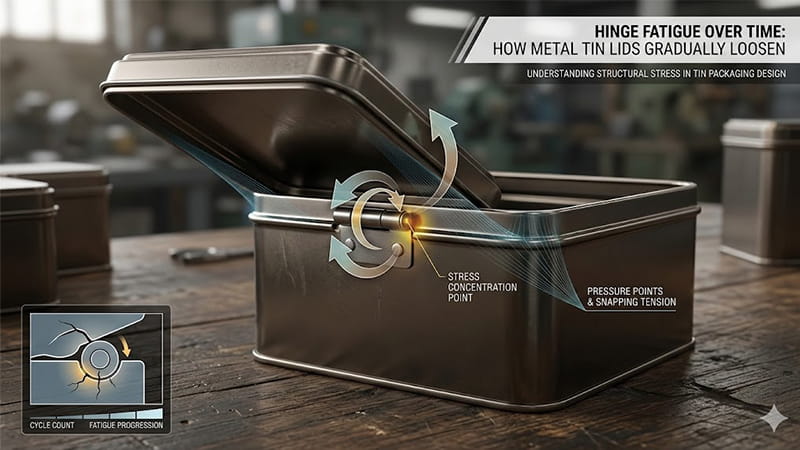
When a lid rotates on a pivot, all mechanical force passes through a very small area.
At the beginning, the snap feels tight. Clean. Defined.
After thousands of cycles, what tends to happen is not breakage, but tension softening.
The metal at the hinge area experiences repeated micro-deformation. Even if the deformation is extremely small each time, it adds up.
In large wholesale bulk orders, especially when products are meant for repeated consumer use, this becomes more noticeable after months in circulation.
And it’s not only about opening frequency.
We’ve seen cases where export shipments stored in humid ports show slightly reduced snap resistance before retail display even begins. Temperature variation and vibration during sea freight can accelerate elastic relaxation.
This is simply how metal behaves.
Tinplate has flexibility, but it doesn’t “remember” perfectly forever.
When a metal tin lid relies on snap pressure to stay closed, that pressure is created during forming. Over time, especially under constant load or vibration, part of that stored energy may relax.
In tin box durability discussions, this is often misunderstood as a material defect. In most cases, it’s not.
It’s material physics combined with structural design.
Increasing thickness sometimes helps, but it doesn’t fully eliminate elastic memory loss. Geometry matters more than people expect.
Samples are controlled tightly.Mass production lives inside tolerance ranges.
Even in a well-controlled tin box manufacture environment, stamping dies operate within measurable variation. Lids and bases are formed separately. If both fall toward opposite ends of tolerance range, the final fit may feel slightly lighter.
It’s not out of spec.
It’s within industrial reality.
This is where certain tin packaging design choices become more forgiving than others.
Structures that distribute contact across a longer surface — such as a sliding lid mechanism — tend to absorb tolerance variation more evenly.
Where force is concentrated at one snap point, variation is more noticeable.
Sliding structures are not immune to change.
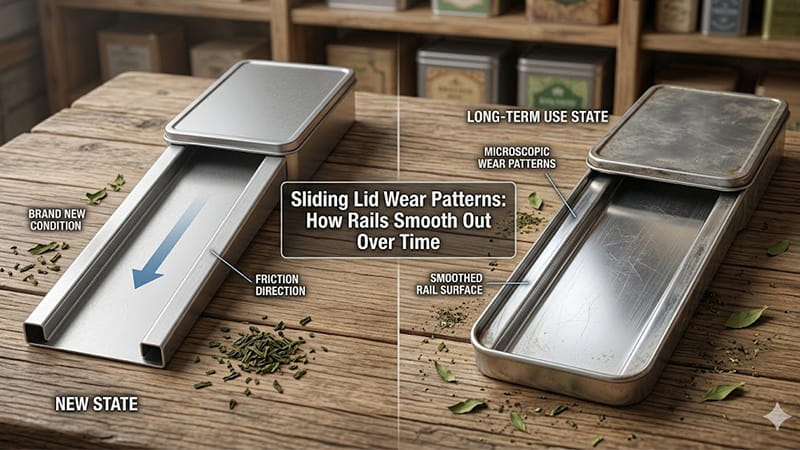
With a sliding lid mechanism, resistance comes from friction along guide rails. After extended use, those surfaces polish slightly. The lid may feel smoother over time.
But what we often notice is that alignment remains stable. Wear spreads across contact surfaces rather than focusing in one pivot location.
In most export cases involving reusable packaging or collectible tins, sliding structures generally perform more predictably over longer distribution cycles.
Again, this depends heavily on rail depth, overlap length, and forming precision during tin box manufacture.
When buyers discuss tin box durability, they often imagine opening and closing cycles.
What they rarely factor in:
Metal expands. Contracts. Reacts to pressure.
For factory wholesale export shipments moving through multiple climate zones, these small dimensional changes can influence lid feel even before the product reaches consumers.
It’s subtle. But across tens of thousands of units, subtle differences become visible.
In real production terms, it’s usually the interaction between:
Very rarely is loosening caused by a single mistake.
When discussing bulk manufacture orders, we usually focus less on simply increasing thickness and more on adjusting structure:
Small geometric adjustments often improve long-term stability more effectively than adding material weight.
We don’t see lids suddenly “fail.”
What tends to happen is quieter:
The snap becomes softer.
The resistance becomes smoother.
The mechanical feedback changes.
A metal tin lid rarely tells you it’s wearing out — it just slowly feels different.
Understanding that difference early, during tin packaging design, helps prevent surprises later in distribution.
For brands placing large wholesale bulk orders, this isn’t just a technical curiosity. Across high-volume production, long-term structural behavior becomes a commercial consideration.
Not dramatic.
But measurable over time.

Holen Sie sich die neuesten Informationen und Sonderangebote


 IPv6-Netzwerk unterstützt
 Deutsch
 English
 Français
 Español
 Português