
Tinplate—essentially thin steel coated with a protective layer of tin—remains one of the most widely used materials for food cans, biscuit tins, and general-purpose metal packaging.
Yet the question persists across supply chains and consumer markets: how long can tinplate resist corrosion under real-world conditions?
Recent case studies, production standards, and accelerated-aging tests reveal that tinplate performance varies greatly with environment, coating thickness, and handling practices.
The longevity of tinplate depends fundamentally on whether the electroplated tin layer remains intact.
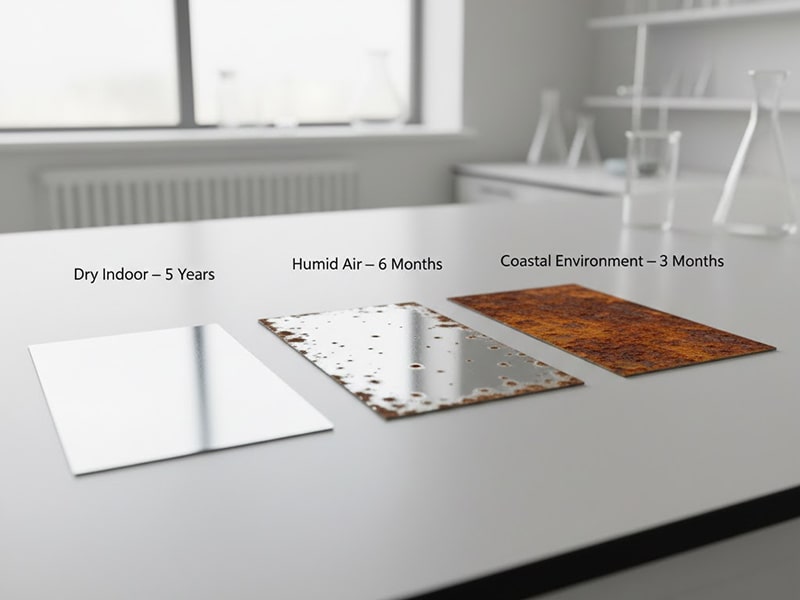
When undamaged, this coating slows oxidation to a minimal rate. In cool, dry, and pH-stable environments, tinplate can remain clean and corrosion-free for five years or longer.
However, higher humidity and airborne moisture degrade the coating more rapidly. In typical open-air, humid storage conditions, manufacturers observe initial pin-prick rusting after around six months. In coastal zones with salt-laden air, early rust spots may appear within three months.
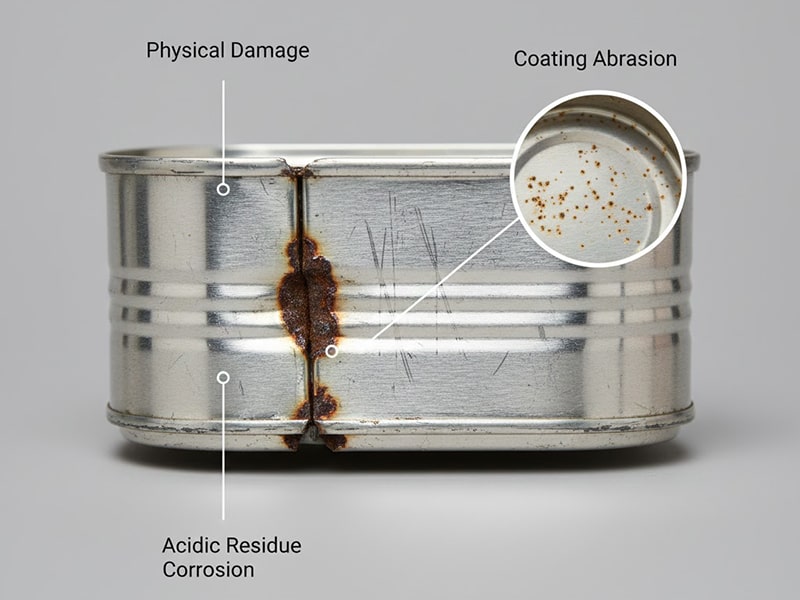
Scratches, dents, and metal-to-metal abrasion expose small areas of bare steel—prime sites for oxidation.
Common examples include:
During transportation, friction at the edges creates micro-exposed points that become early rust origins.
Household tin containers, such as tea tins used in kitchens, often show darkening around clasps within two years of regular use.
When a tin is dropped or heavily bent, the compressed metal area may show visible brown corrosion within a month.
Such patterns indicate that physical integrity is as critical as chemical protection.
Corrosion intensifies when acidic food residues remain inside tinplate containers.
Historical documentation from Tokyo’s Koto Ward (1999 warehouse collapse investigation) demonstrated this effect clearly:
This case confirms that leftover organic acids significantly accelerate internal corrosion even when external conditions remain stable.
The durability of tinplate differs widely depending on coating weight.
Under China’s QB/T 276-2007 standard, tinplate should have at least 11.2 g/m² of tin on the surface.
Yet some low-cost manufacturers supply material with only 9 g/m² on both sides, falling below compliance.
Field observations show that:
Standard-grade tins stored indoors remain rust-free for 8–11 years.
Non-standard material develops edge rust after extended use and may show perforation after 12+ years of exposed storage.
Tinplate used in architectural or outdoor environments requires extra protection.
A study from Pahang, Malaysia, reported that tinplate roof panels installed outdoors experienced 20% waterproofing failure within four months, mainly due to humid tropical monsoon conditions.
Moisture triggered tin activation and the formation of hydroxide compounds that weakened the coating.
The research recommended quarterly maintenance in regions affected by seasonal monsoon airflow.
Small rust spots—particularly those under 0.5 mm—must be treated early.
Evidence from Shenyang Sanyo Metal laboratory test found:
Untreated rust nodes expanded into 2–3 mm oxidation zones within 72 hours at 80% humidity.
Over 30 days, corrosion radiated across 15 concentric layers of metal, enough to compromise structural stability.
The most effective mitigation involves mechanical polishing followed by composite re-coating and food-grade anti-rust sprays.
Table: Tinplate Rusting Durations by Environment & Material Grade
| Condition / Scenario | Expected Rust-Free Duration | Key Risk Factor |
|---|---|---|
| Cool, dry indoor storage | 5+ years | Stable humidity & intact coating |
| Humid indoor air | ~6 months | Moisture weakens tin layer |
| Coastal, high-salt environment | ~3 months | Salt accelerates oxidation |
| Standard tin coating (≥11.2 g/m²) | 8–11 years | Meets national coating standards |
| Substandard tin coating (9 g/m²) | Below 8 years | Insufficient tin thickness |
| Kitchen-use containers | Darkening after ~2 years | Frequent handling + heat |
| Severe dents or deformation | Rust visible in ~1 month | Exposed base steel |
| Outdoor monsoon climate (Malaysia case) | Waterproofing failure in 4 months | High humidity & rainfall |
| Untreated micro-rust (<0.5 mm) | Expansion in 72 hours | Rapid oxidation under 80% humidity |
Protection must address both physical integrity and chemical stability:
Conduct weekly inspections for dryness.
Use protective film on contact points during storage.
Introduce inert-gas sealing during high-humidity seasons (every 18 months).
Install dehumidification systems in warehouses—tests from Kaohsiung Port facilities showed rust-prevention effectiveness increased threefold with controlled micro-environments.
Tinplate lifespan correlates directly with structural integrity, making ongoing preventative maintenance essential.
From a production standpoint, tinplate corrosion is rarely caused by a single factor. Tin packaging manufacturer note that:
The coating uniformity, not only its nominal weight, is critical. Variations of just 5–8 microns between sections can create weak points.
Many failures originate during logistics, not manufacturing—especially when tins are stacked without corner protectors.
Modern food-grade lacquers significantly extend lifespan, yet cost-driven buyers often skip internal lacquer on non-food tins, shortening durability by up to 40%.
The largest improvement seen in the past decade comes from controlled-environment packaging, where tins are sealed immediately after production to prevent early humidity contact.
With proper coating and handling, tinplate products are fully capable of achieving a decade or longer of reliable performance.
Holen Sie sich die neuesten Informationen und Sonderangebote


 IPv6-Netzwerk unterstützt
 Deutsch
 English
 Français
 Español
 Português