
In the past, packaging design mainly focused on two requirements: it had to fit the product and it wouldn't damage during transport. But now, many of our brand clients have a different mindset—packaging also needs to tell a compelling environmental story, make the product seem more valuable, and even encourage customers to look at it again after purchase.
Therefore, in the past two years, clients in industries like tea, candy, candles, cosmetics, and gifts have increasingly started inquiring about reusable packaging. They not only want it to look good, but also want it to be durable and reusable, so the brand can stay in customers' homes longer, instead of being thrown away immediately after opening.
Metal packaging perfectly addresses this need. With proper design, it can be both sophisticated and durable, and is naturally suited for repeated use—something many cardboard boxes and plastic bags simply cannot achieve.
At TinBoxesChina, we’ve helped over 200 brands launch custom reusable metal packaging — from mint tins to refillable cosmetic jars. [Contact us to request design samples or a quote.]
In this guide, we will share how reusable metal packaging works for consumer brands, where it makes the most sense, what materials to consider, and what we usually recommend when brands want packaging that customers are more likely to keep.
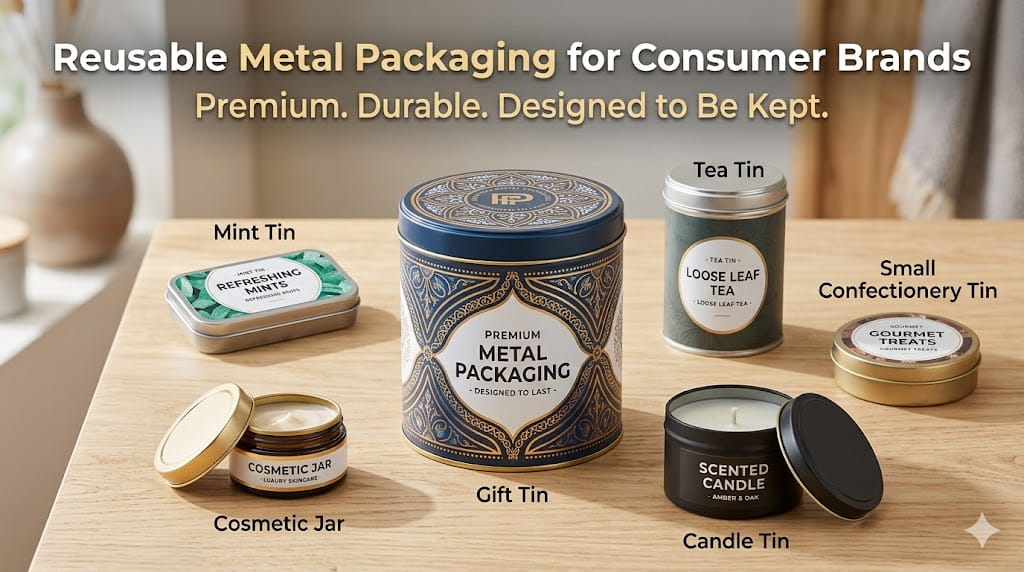
Reusable metal packaging is not simply metal packaging that can technically be used again. In practice, it means packaging designed with a second life in mind.
That second life may be very simple. A customer finishes the candy and keeps the tin for storage. A tea tin becomes part of a kitchen setup. A candle tin is reused on a desk or shelf. A cosmetic jar is refilled instead of replaced.
For consumer brands, this matters because reusable packaging changes the role of the pack. It is no longer just a shipping or retail container. It becomes part of the product experience, part of the brand story, and in many cases, part of the customer’s daily environment.
From what we see in the market, the best reusable metal packaging projects usually have three things in common: they look premium, they feel durable, and they are practical enough that the customer actually wants to keep them.
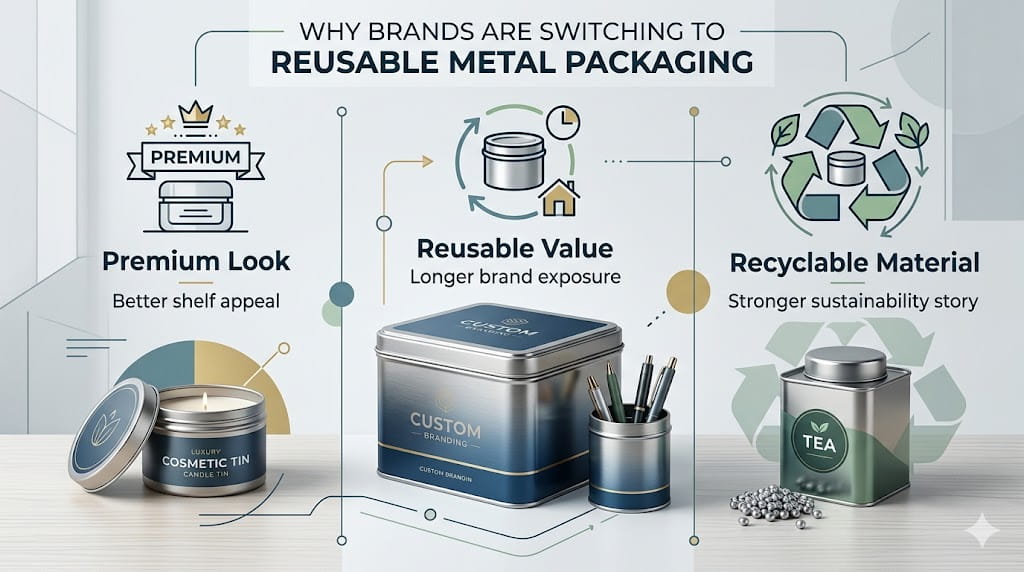
Metal packaging has a strong visual and tactile advantage. The weight, the surface finish, the sound of opening and closing, and the overall rigidity all contribute to a more premium impression.
For categories where presentation matters, such as gift packaging, tea, confectionery, candles, and cosmetics, that premium feel can influence buying decisions immediately.
A well-designed tin box or metal container often stays in the home long after the original product is gone. That is one of the biggest differences between reusable metal packaging and disposable paper or plastic formats.
When a customer keeps the pack, your brand stays in sight longer. That extended visibility can be more valuable than many brands initially expect.
Reusable metal packaging helps reduce the “use once and discard” pattern that many brands are trying to move away from. In addition, metals such as tinplate and aluminum have strong recycling value and fit well into circular packaging discussions.
For brands that want a more credible sustainability story, reuse plus recyclability is a much stronger combination than recyclability alone.
Some packaging formats are naturally more reusable than others. Decorative tins, candle tins, tea tins, and metal cosmetic containers often perform better because they already fit into home storage, gifting, or display use.
That is why reusable metal packaging is often a better strategic fit for consumer brands than people assume at first.
Not every product needs reusable packaging. But for the right category, it can add real value.
We usually see the strongest fit in:
Last year, a tea brand came to us wanting a reusable tin that could also serve as a gift box. We recommended a two-piece tinplate structure with a clear PET lid. The result sold out during the holiday season, and over 30% of customer reviews mentioned that they kept the tin after finishing the product.
This is exactly where reusable metal packaging becomes more than a container. It becomes part of the customer’s reason to remember the brand.
For most consumer brands exploring reusable metal packaging, the material decision usually comes down to tinplate or aluminum.
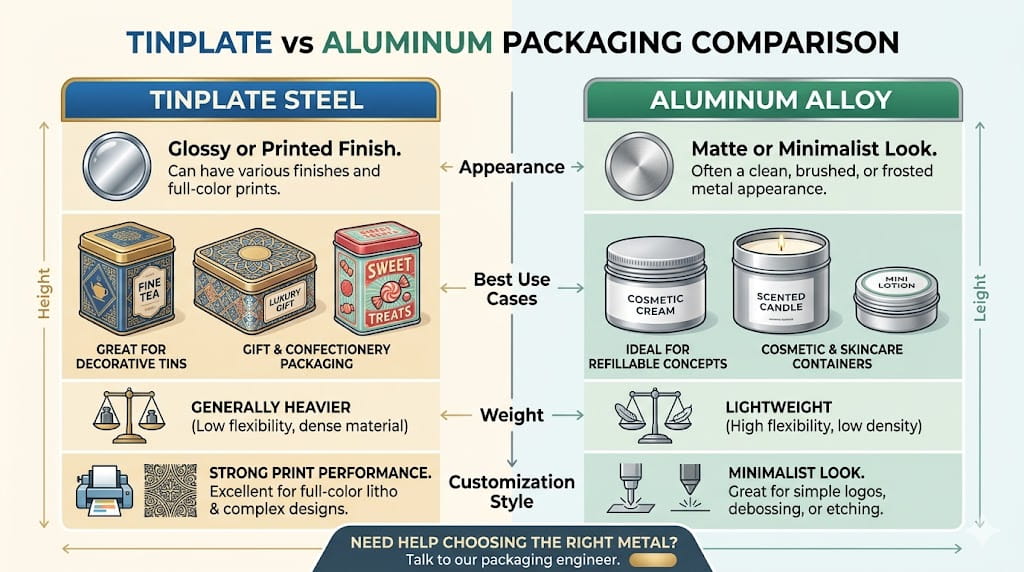
Tinplate is one of the most widely used materials for custom decorative packaging. It offers good strength, strong print performance, and a wide range of shaping and embossing options.
It is often a good choice for:
From a design point of view, tinplate is flexible and cost-efficient for many custom shapes and printed finishes. It is especially useful when shelf appeal and decoration play a major role in the packaging strategy.
Aluminum is lighter in weight and often gives a cleaner, more modern look. It is a strong option for brands that want a minimalist, refillable, or more contemporary packaging direction.
It is often a good choice for:
Aluminum can also be attractive for brands that want to reduce shipping weight or build a lighter-feel sustainability narrative.
Not sure whether tinplate or aluminum works better for your product? We offer free material consultation based on your product type, target price, and sustainability goals. [Talk to our packaging engineer →]
A metal pack is not reusable just because it is made of metal. If the structure is weak, the finish scratches too easily, or the pack is inconvenient to use, customers will still throw it away.
In our experience, successful reusable packaging usually depends on five practical design decisions.
The lid fit, hinge quality, edge treatment, and body strength all matter. Reusable packaging should still feel good after repeated opening and closing, not only when it first leaves the factory.
We regularly test reuse durability. Our standard tin boxes go through 50+ open-close cycles and a 1-meter drop test without denting visible decoration. For brands developing reusable packaging, these details matter much more than they do in ordinary promotional packaging.
One of the easiest mistakes is designing a pack that looks beautiful but is not practical to keep. Reusable packaging should be easy to open, easy to store, and useful after the original product is gone.
A tea tin, for example, should still feel functional in a kitchen. A candle tin should still look good on a shelf. A cosmetic jar should feel clean, sturdy, and convenient enough to refill.
If a package is meant to stay with the customer, the printing and finish have to last. Scratches, fading, weak embossing, or poor varnish can reduce the chance that the customer keeps the pack.
This is why we usually spend extra time with clients on finish selection, decoration durability, and surface protection, especially for gift-oriented products.
Reusable packaging works best when the visual design makes sense for the brand. A vintage tea brand may need classic decorative tinplate. A premium skincare brand may prefer matte aluminum with a clean refillable look. A holiday confectionery line may benefit from collectible seasonal artwork.
The packaging should feel like something worth keeping, not just something made from a durable material.
This is especially important for food, skincare, cosmetics, wax products, and products with oils or active formulas. Inner coating, sealing, and material compatibility should be confirmed early in development.
We always recommend discussing filling conditions, formula characteristics, and expected shelf life before moving too far into sampling.
Reusable metal packaging can create strong value, but it is not something to approach casually. Good projects usually succeed because brands understand the real trade-offs from the beginning.
Metal packaging often costs more upfront than folding cartons, plastic jars, or flexible pouches. That is true. But the better question is whether the packaging creates more value over time.
If the packaging improves perceived product value, supports premium pricing, increases gift appeal, gets kept by the customer, and strengthens brand memory, the higher initial cost can make commercial sense.
Not every reusable packaging project needs a formal return-and-refill logistics system. In fact, for many consumer brands, the most realistic model is simply consumer-level reuse.
That means the customer keeps the pack and continues using it at home. This is often far easier to launch than a full reverse logistics program, while still creating meaningful sustainability and branding value.
Some metal packaging is decorative but not durable enough for repeated real-life use. Some looks good but is inconvenient to clean or store. Some structures are fine for promotional use but not ideal for refill or long-term retention.
That is why reusable packaging should be developed differently from standard one-time packaging.
For most brands, we do not recommend trying to redesign the entire packaging line at once. A better way is to start with one product or one campaign where reusable packaging can deliver obvious value.
That may be:
Start with a product that already has strong visual appeal or repeat-use potential. Test the structure, gather customer feedback, and then decide whether to expand.
This step-by-step approach is often the safest way to balance cost, speed, and packaging performance.
The strongest reusable packaging projects are not just about replacing one material with another. They change how packaging works for the brand.
Instead of disappearing after purchase, the pack keeps working.
It protects the product.
It improves shelf presence.
It supports sustainability messaging.
It stays in the customer’s environment longer.
And in many cases, it increases the perceived value of the product itself.
That is why more consumer brands are treating reusable metal packaging as a brand asset rather than just a packaging cost.
Reusable metal packaging is not the right solution for every product. But for consumer brands that want premium presentation, better long-term visibility, and a more durable sustainability story, it is one of the most practical packaging directions to explore.
The key is not simply choosing metal. The key is designing packaging that customers genuinely want to keep.
At TinBoxesChina, we work with brands that want more than a standard tin box. They want packaging that fits their product, supports their market positioning, and creates value after the sale — whether that means a collectible gift tin, a refillable cosmetic container, or a reusable tea box that becomes part of daily life.
Ready to turn your packaging into a reusable brand asset?
[Get a free reusable packaging feasibility review]
Holen Sie sich die neuesten Informationen und Sonderangebote


 IPv6-Netzwerk unterstützt
 Deutsch
 English
 Français
 Español
 Português