
Fresh-roasted coffee, when placed in a package, keeps changing.
Roasting locks carbon dioxide into the porous structure of the beans. Some of that gas slowly leaks out during storage. Again, grinding changes the release pattern by exposing more surface. If you seal coffee too soon, pressure can build up inside the package. Oxygen can get into the package and it can lose aroma and flavor.
That’s why roasters sometimes request a degassing valve on a coffee tin.
The question seems simple. But the choice of packaging is not.
The gasses produced by roasting include carbon dioxide. Some gas is released during and right after roasting, and some gas stays inside the roasted bean. During storage it then slowly comes out and can be released more quickly after grinding.
Research from the Coffee Excellence Center at Zurich University of Applied Sciences shows the gas release is different between whole beans and ground coffee and is influenced by roast conditions and storage. Every coffee has a degassing timetable that is none. Read the Coffee Roasting Degassing study.
The following variables can influence the packaging requirement:
So fixed rules such as whole beans require a valve for four weeks or ground coffee never requires a valve are too broad to be applied to a commercial specification.
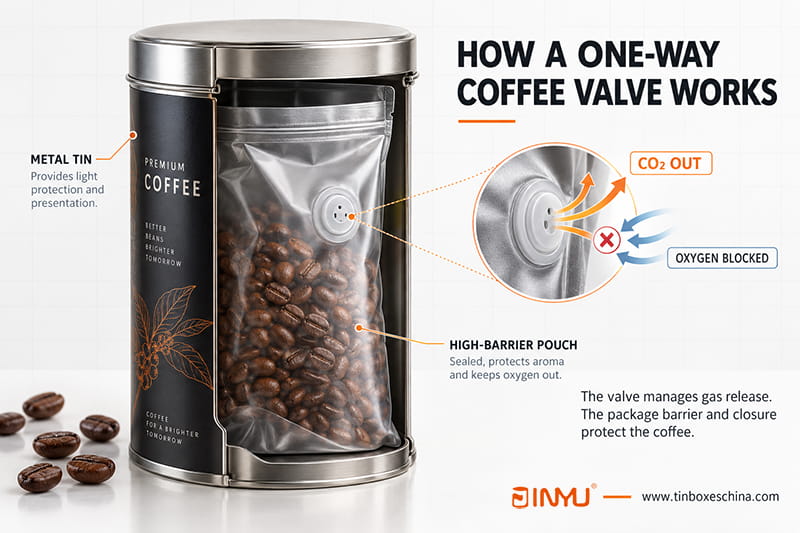
A one way valve is meant to allow gas to escape from the package but prevent outside air from entering. If the internal pressure exceeds the valve’s opening condition, the valve will vent gas. The pressure drops again and the valve closes.
This type of component is described by WIPF as an aroma protection valve, which is intended to release gasses such as CO2 while protecting the package from the external air. WICOVALVE WIPF data
Goglio also provides different valve configurations for flexible, rigid and semi-rigid packaging, including high-flow or higher-pressure versions. Valve technologies Goglio
The valve is just a part of the system. It doesn't. :
A good way to explain it to a buyer is:
The valve controls the gas flow. The package barrier and closure protects the coffee.
We typically begin a coffee tin project with four questions.
Whole beans and espresso grind and filter grind don't act the same. Add more than “coffee” to the product description.
Record:
Packing two days after roasting is a different gas management problem than packing two weeks later.
Timing is expected to include:
The longer the coffee is exposed before sealing, the more freshness can be lost. Allowing for degassing is not automatically better if the coffee is just left exposed to air.
The valve can be a part of:
Location effects on sealing, filling, folding, clearance and inspection
Ask how you want your coffee
So a pack that is difficult to close after opening but that survives the first week of use has not been fully evaluated.
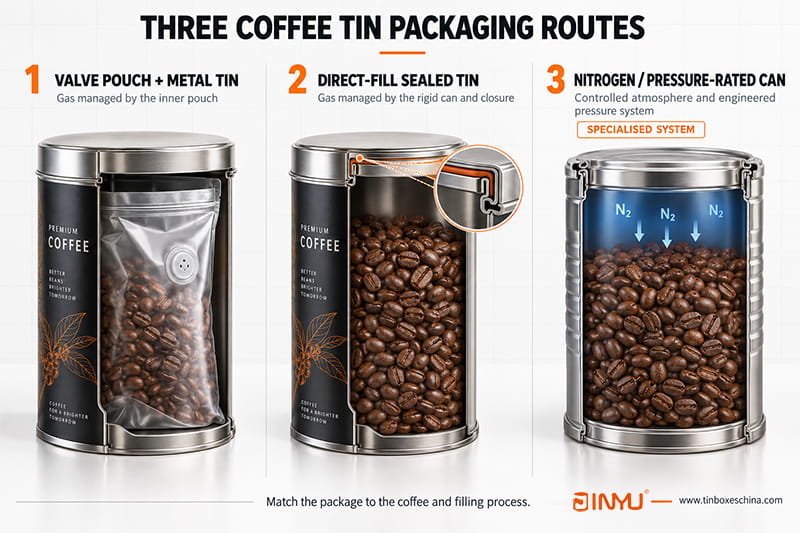
| Packaging type | Where gas is handled | When it may be appropriate | Main checks |
| Valve pouch in metal tin | Gas free | Fresh coffee packed during degassing, with tin as outer package | Valve position, pouch barrier, fold height, lid clearance and leakage |
| Direct-fill rigid tin, sealed closure | Rigid can, sealed closure | Coffee with controlled degassing or a process for rigid packaging | Seam, gasket, internal pressure, closure fit, package integrity |
| Rigid can, nitrogen flushed or pressurized | Controlled atmosphere and pressure system | Premium systems with appropriate filling equipment and pressure-rated components | Gas sequence, residual oxygen, pressure, seam performance and opening method |
You are trained on data up to October 2023.
The first route is often the best first step for a brand wanting a metal coffee tin look but still wanting a flexible package with a valve.
The second way is more care. A common decorative tin should not be considered a pressure vessel.
The third way is a separate packing technology. illy, for example, packages its freshly roasted coffee in recyclable tins pressurized with inert nitrogen. That system is proprietary process and suitable can construction, not just a normal tin with an extra lid hole. illy packaging & pressurization explanation
Whole bean coffee generally holds gas inside the bean longer. If it is packed very soon after roasting, the package might need a controlled way to handle the pressure that builds later.
Grinding the coffee exposes more surface area. It can release gas more quickly, but this does not mean that every pack of ground coffee can be specified without a valve. Even a big fill packed soon after grinding may need testing.
Roast degree is also important. A darker roast may have a more open internal structure . Different roasting and cooling profiles can lead to different release behavior .
This is why we do not write a specification like:
Ground coffee doesn’t need a degassing valve.
A more useful statement is:
Ground coffee may require a different gas handling process. Check the route with actual roast, grind, pack size and fill time.
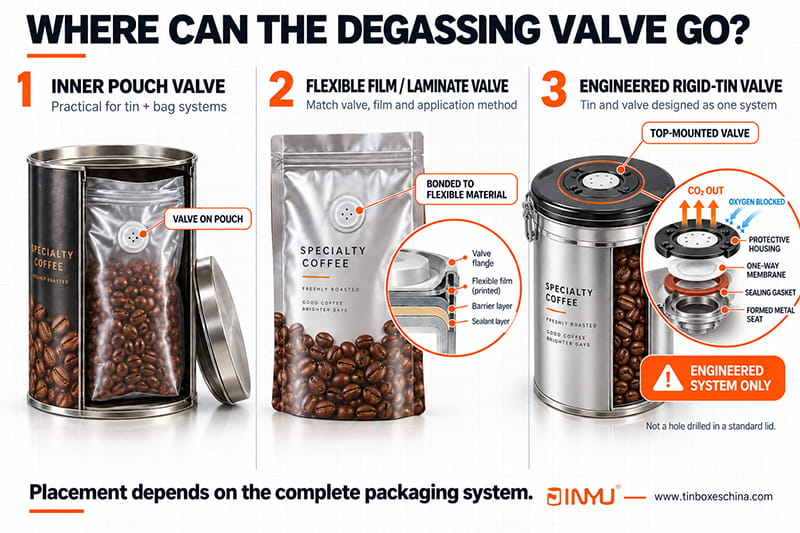
This is often the most practical arrangement for a coffee tin with an inside bag.
The pouch can be configured to have:
The valve must be exposed to the gas space of the pouch. It should not get caught under a folded corner, pressed against the tin wall or blocked by coffee fines.
The filled pouch also needs to slide through the opening in the tin without tearing or requiring too much force.
Some of the premade bags and flexible laminates are designed for use with valves during bag making or filling. The valve, film, sealant and filling equipment need to be matched.
Request to supplier:
There is no one opening-pressure value that can be applied to all valves. The correct data is for the precise model and package build.
This is only possible when the tin and valve are engineered as one system.
The project may need:
Don’t expect the tin supplier to drill a standard lid once artwork is approved. The opening can decide the structure, seal and appearance of the whole package.
The metal body protects the coffee from light and provides the brand with a durable retail format. The body does not control the release of CO2 by itself.
The important dimensions for a tin with valve pouch are:
The body can accept a pouch and still not allow the lid to seat properly. A valve can function in the open sample, but become blocked when the pouch is folded.
For direct-fill coffee tins, watch out for:
A tin labeled ‘airtight’ must still be checked as a fully filled package. The word does not describe what the package will do as CO2 is still being released.
Nitrogen Flushing Cuts Oxygen in Package Atmosphere It does not stop roasted coffee from creating or releasing CO₂.
That is an important difference:
Some systems do not have a valve and use nitrogen. Some use nitrogen and valve pouch together. Some have a rigid pressurized canister. The right answer depends on the real process.
If the buyer says, “We use nitrogen, so we don’t need a valve,” the next questions are:
A roaster wants a printed cylindrical tin for whole beans packed soon after roasting. The first thought is to fit a valve in the lid.
First we would compare the valve pouch inside the tin to a direct fill rigid structure. For the pouch option, the critical review points are the valve position, folded pouch height and space under the inner lid.
If the valve is under the folded shoulder, a different pouch width, fold or valve position may be the solution. Rarely is the first solution to drill the finished tin.
Brand uses nitrogen purging, assumes valve testing not necessary.
A better way to do this is to test the actual grind, fill weight, filling speed and seal sequence. For the project, if the package is stable and the residual oxygen results are within the agreed specification, a valve in the tin may not be necessary. If the coffee is packed very quickly after grinding and the pressure keeps building, a valve pouch can still be useful.
The decision is based on the way of filling and not on the word nitrogen in the quotation.
A gift brand will plan to pack coffee well before the customer receives it. Design team wants a visible valve because it appears technical.
We would ask if the valve is solving a true pressure problem. A visible valve can add cost and another sealing point without improving the customer experience if the coffee is rested prior to packing and the final package is stable.
A valve pouch might be a more controlled method if the packing date is near roasting and the storage duration is unknown. The outer tin can still provides the visual design, while the inner pouch handles the coffee barrier and gas release.
Some high-end coffee brands use a rigid can with nitrogen and controlled internal pressure. It is a specialist system involving the can body, ends, seams, filling equipment and opening method.
It should be a full-stack solution built from scratch. You cannot assume that a standard decorative tin will do the same.
The valve decision should be tested with real coffee and the intended packaging.
Record:
Use common production coffee. A carefully selected display sample may not have the fines, density or gas release of the normal batch.
Gather:
For a direct fill project, supply the actual tin body and closure to be used in production.
Use the same:
Do not push coffee into a smaller tin by hand where the production line will not.
Look for:
Take photographic records of the filled pack before leaving the test bench.
At agreed checkpoints, verify:
Acceptance criteria agreed with roaster, filler and packaging supplier. A valve supplier laboratory result is not the same as a test on the finished coffee pack.
Load the samples in your desired shipping configuration. Reexamine the package after appropriate drop, vibration or compression testing.
Then open the can as a customer would.
A package that is awkward to open but makes it through transit may need a different opening for a pouch, lid or tin.
Don’t ask for “just a coffee degassing valve”.
For information on:
Gog lio's range of products is proof of the need to select specific valves based on the application, with versions available for low opening pressure, high flow, rigid or semi-rigid packages, fine particles and recyclable structures. Goglio valve choices
Freshness is not the defining factor of the package. The roast to pack interval is important, as is the closure system.
Ground coffee can blow off gas quickly after grinding. Its value will be defined by the actual filling process.
Nitrogen displaces the oxygen in the package. It doesn’t automatically stop CO₂ emissions
A simple hole cannot provide a controlled one way gas release. It can cause a leakage path, and affect the lid or seam.
Seeing a valve doesn’t mean better coffee protection. Functional performance should determine location.
There is no way an empty tin can demonstrate how coffee fines, a filled pouch, gas release or the actual fold will work.
Design determines valve performance. Request data on the specific component and test in the finished pack.
The bag can be physically closed and you will lose the aroma of the coffee. Consideration should be given to sensory, oxygen and storage checks together.
Nope. Controlled venting is useful in a system that must vent gas when the coffee continues to off-gas sufficiently to affect package pressure. Other systems include a resting period, nitrogen flushing, or pressure rated rigid packaging.
They might, especially if filled with fresh whole beans soon after roasting. A valve pouch inside the tin is often easier to develop than a valve built into the metal body.
Not by default. Ground coffee can degas rapidly but the outcome depends on grind size, roast, pack time, fill weight and closure.
Only with a structure designed and tested for that valve. Do not alter a standard lid without verifying its sealing, food contact, mechanical strength and filling compatibility.
Sometimes the pouch in a tin with an inner pouch is a better spot. “The valve is still part of the flexible coffee package, while the tin offers light protection and brand presentation.”
Sometimes, but not necessarily. Nitrogen displaces oxygen in the headspace but does not prevent continued C02 evolution. Before you remove or add a valve, test the entire process.
Properly specified valves can help protect package integrity and reduce ingress of outside air . Shelf life also depends on the quality of the coffee, the barrier material, the oxygen level, sealing, storage and distribution.
Better to decide during the structure & filling review. Adding a valve at a later date may change the lid, artwork, tooling, sealing method and inspection plan.
Yes. This is a useful structure for brands that want the look and re-usability of a tin, but want to retain gas management within a flexible inner package. Check pouch fit, valve clearance, lid fit and access for opening.
When requesting a coffee tin quotation please include:
In a comprehensive packaging discussion, Jinyu can review the metal structure, tin dimensions, lid arrangement and inner-pouch fit. Check out our custom metal coffee tin packaging, compare available tea and coffee tin structures or send us your packaging brief.
Custom printed production begins at 5,000 pieces per size and design. The sample time is usually 7-10 days, the mass production time is usually 25-35 days after the sample approval, depending on the final structure, artwork and filling requirements.
The design of the coffee tin should be based on the coffee and the filling route. Once those conditions are clear the valve decision is much easier to make.

Holen Sie sich die neuesten Informationen und Sonderangebote


 IPv6-Netzwerk unterstützt
 Deutsch
 English
 Français
 Español
 Português