
Sliding lid tin boxes are simple, compact, and easy to use. They are often used for mints, candies, lip balm, solid perfume, small gifts, and promotional products. The lid does not lift up or twist open. Instead, it slides along the tin body. This makes the packaging feel smooth, clean, and convenient.
As a professional tin box manufacturer in China, we often help brands choose between sliding lid tins, hinged lid tins, friction lid tins, and screw-top tins. From our factory experience, a sliding lid tin box is a practical choice when portability, repeated opening, and compact structure matter.
For many brands, this type of tin is more than a container. It is part of the product experience. When a customer opens the tin with one hand, carries it in a pocket, or reuses it after the product is finished, the packaging continues to show the brand.
However, this structure is not suitable for every product. Sliding lid tin boxes have clear advantages, but they also have limitations, especially in sealing performance, internal volume, and sliding tolerance.
Before choosing this structure, buyers should understand how it works, what products it fits, and what design details need attention.
This guide explains the best uses, sealing limitations, and important design tips for custom sliding lid tin boxes.
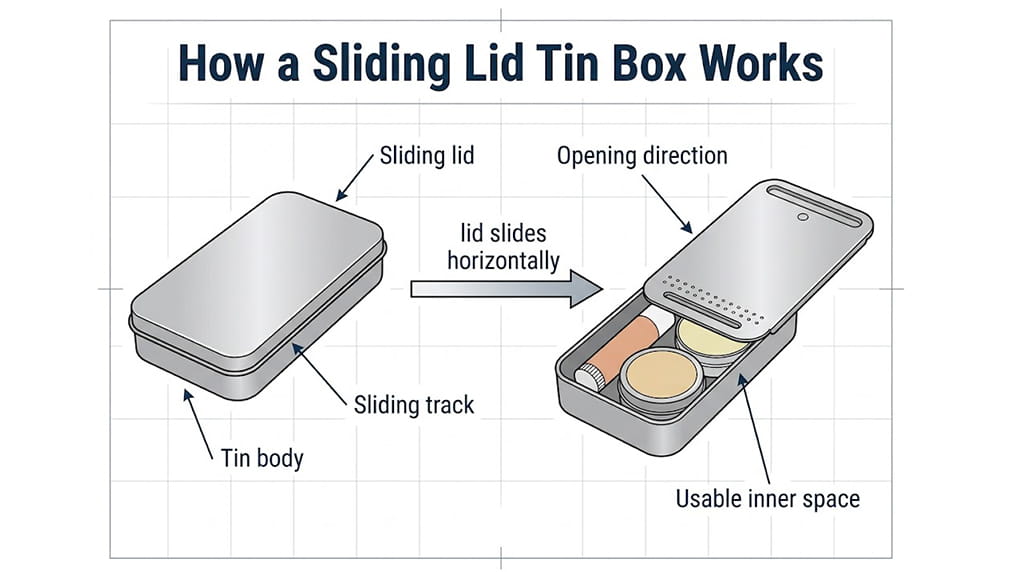
A sliding lid tin box is a metal tin box with a lid that moves horizontally. The lid slides open and closed along the edge or track of the tin body. Most sliding lid tins are rectangular, square, or slim in shape.
This structure is different from a hinged lid tin, a screw-top tin, or a lift-off lid tin.
A hinged lid opens from one side and stays connected to the box. A screw-top lid twists open. A lift-off lid needs to be pulled upward. A sliding lid tin opens by pushing the lid sideways.
This makes sliding tin boxes very useful for small products that need quick access. The user can often open the tin with one thumb. This is why sliding lid tins are popular for portable packaging.
From a manufacturing point of view, the performance of a sliding lid tin box is not decided by shape alone. It depends on the balance between tinplate thickness, rail tolerance, lid resistance, edge control, and surface finish. A small change in any of these details can affect how the tin opens and closes.
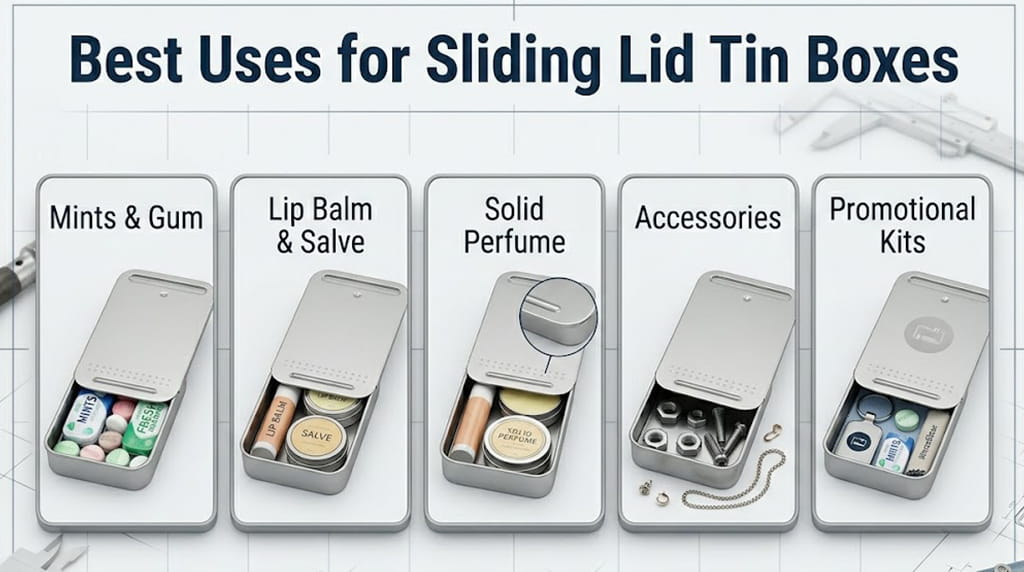
Sliding lid tin boxes work best for products that are small, dry, compact, and used often. They are especially suitable when the customer needs easy opening and repeated use.
Mints are one of the most common products for sliding lid tins. A mint tin with a sliding lid is easy to open in daily life. Customers may use it while driving, working, walking, or traveling. In these situations, they do not want to struggle with a tight lid.
A sliding lid allows fast access. It also keeps the tin small and pocket-friendly. For mint brands, this structure gives both convenience and a clean retail look.
When using sliding tins for mints, buyers should check the food-contact requirement, inner packing, and opening size. If the mints are loose inside the tin, the lid movement and gap control should be tested carefully.
Sliding lid tin boxes are also suitable for lip balm, salve, wax-based skincare, and other solid personal care products. These products are usually small and used many times. A reusable tin package can make the product feel more premium.
For this type of product, the opening should be wide enough for easy use. The inner coating should also match the product formula. If the product touches the tin directly, buyers should confirm material safety and surface treatment before production.
A smooth sliding lid can improve the user experience. If the lid is too tight, customers may feel frustrated. If it is too loose, the packaging may feel cheap. A good balance is important.
Solid perfume, mini cosmetic products, and sample sets can also use sliding lid tin boxes. The metal surface gives a strong brand image. Custom printing, embossing, debossing, matte finish, glossy finish, or metallic effects can all help create a premium look.
For cosmetic packaging, the surface finish is very important. A matte finish may look soft and high-end. A glossy finish may look bright and clean. A metallic effect can show the natural shine of tinplate.
However, the sliding area may create friction during repeated use. The artwork should be designed with this in mind. Important logos or fine details should not be placed in areas that rub heavily during opening and closing.
Sliding lid tin boxes can be used for small accessories such as pins, clips, sewing kits, small tools, craft items, and travel kits. The tin box protects the product and keeps small items organized.
For these products, the buyer should check the inner space carefully. The outside size is not the same as the usable inside space. The sliding structure, rounded corners, and wall shape can reduce the actual space inside the tin.
If the product has sharp edges or heavy parts, the tinplate thickness and box strength should also be tested.
Sliding lid tins are also a good choice for promotional gifts, sample packs, and brand campaigns. They are small, reusable, and easy to carry. After the original product is used, customers may keep the tin for storage.
This is useful for brand exposure. A reusable tin can stay on a desk, in a bag, or at home for a long time. Compared with disposable packaging, a well-made tin box can give the brand more lasting visibility.
For promotional projects, existing molds are often a practical choice. They can save mold cost and shorten development time. The brand can still use custom printing to create a unique appearance.
Sliding lid tin boxes are popular because they offer several clear advantages.
The biggest advantage is convenience. The user only needs to push the lid sideways. There is no need to pry, twist, or pull with strong force.
This makes the package suitable for daily-use products. For mints, balm, or small cosmetics, easy opening is not a small detail. It directly affects the user experience.
Most sliding tin boxes are slim and easy to carry. They fit well in pockets, handbags, travel kits, and retail displays. For products like mints, gum, balm, and small accessories, portability is very important.
A compact tin also helps reduce unnecessary packaging space. This can be useful for retail display, shipping, and promotional distribution.
A sliding lid tin box is designed for repeated opening and closing. When the structure is well controlled, it can give a smooth and stable user experience.
This is one reason why sliding lid tins are often used for products that customers open many times during the day.
Tinplate offers a good surface for custom printing. Brands can use full-color printing, logo printing, embossing, debossing, matte finish, glossy finish, or special coating.
The metal material also gives the packaging a durable and premium feel. For many small products, the tin box can make the product look more valuable.
Many customers keep small tin boxes after use. They may reuse them to store small items, coins, pills, pins, or travel accessories.
This gives the packaging a longer life cycle. It also gives the brand more exposure after the original product is finished.
Although sliding lid tin boxes have many advantages, buyers should also understand their limitations. This is especially important for food, cosmetics, and moisture-sensitive products.
A standard sliding lid tin box should be understood as a basic closure, not an airtight or hermetic seal. Because the lid needs space to slide, there is usually a small clearance around the sliding track.
This clearance is necessary for smooth opening and closing, but it also means the tin itself cannot provide the same sealing performance as a screw-top tin, plug lid tin, or a tin with an additional inner seal.
In simple terms, a sliding lid tin box can help keep the product covered and protected during normal handling. But it should not be used as the only moisture-proof, leak-proof, or aroma-retention solution.
For dry products such as mints, candies, solid balm, or small accessories, this level of closure is often acceptable. But if the product is moisture-sensitive, oily, powdered, strongly scented, or requires a long shelf life, buyers should consider one of the following solutions:
This is why sealing requirements should be confirmed before mold selection and sample approval.
Sliding lid tins are not the best choice for loose powder, very fine granules, or crumbly food. Small particles may enter the sliding track and affect the opening feel. They may also leak through small gaps.
For powder products, a screw-top tin, plug lid tin, or additional inner seal may be better.
If a buyer still wants to use a sliding tin for powder or small particles, the product should normally be packed in an inner bag first. The tin then works as the outer protective and branding package.
Sliding lid tin boxes are usually compact. This is good for portability, but it also means the internal volume is limited. The sliding lid and body structure may reduce the usable space inside.
Buyers should not choose a tin only by its outside dimensions. The product size, fill volume, and user access should all be checked with a physical sample.
For example, a product may fit inside the tin, but it may be difficult to take out. This can happen when the opening is too narrow or the product sits too tightly in the box.
For heavy items, the lid needs enough resistance to stay closed during shipping and handling. If the lid is too loose, the product may move or the package may open. If the lid is too tight, the user experience becomes poor.
This balance should be tested before mass production.
For heavier products, the tinplate thickness, body strength, and lid resistance should be checked carefully. In some cases, a hinged lid tin or friction lid tin may be a better choice.
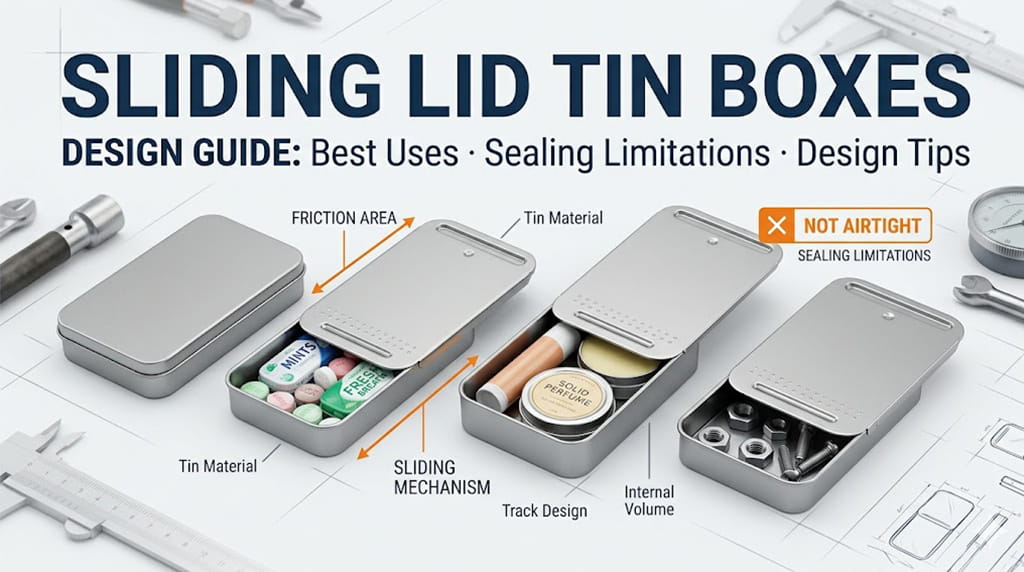
A good sliding lid tin box depends on both design and production control. Small differences in structure can change the opening feel.
Before choosing a tin size, first check the product itself.
Ask these questions:
These questions help avoid wrong size selection.
A tin box is not only a shell. It should match the product, the filling method, the user habit, and the selling channel.
The outside size of a tin box is only a reference. The real usable space may be smaller because of the tin wall, corners, and lid structure.
For example, a product may fit the outside length and width on paper, but it may still be difficult to remove from the tin. This is common when the opening is narrow or the product sits too tightly inside.
A physical sample is the best way to confirm the fit.
Before confirming an order, buyers should check:
The lid should not be too tight or too loose.
If it is too tight, users may find it hard to open. This can create a bad experience, especially for daily-use products like mints or balm.
If it is too loose, the lid may shake, slide open too easily, or feel low quality.
Good sliding resistance depends on accurate mold forming, edge control, tinplate thickness, and production tolerance.
For this reason, sliding feel should always be checked with real samples. A drawing can show the structure, but it cannot show the exact opening experience.
Some sliding lid tins need a stopper to prevent the lid from sliding too far. This detail can improve the user experience and reduce the risk of the lid coming off too easily.
For small tins, the stopper may be simple. For larger tins, the structure may need more careful control.
A good stopper should not make the lid hard to open. It should control the movement in a smooth and natural way.
Tinplate thickness affects both strength and sliding feel. If the material is too thin, the tin body may deform more easily. If it is too thick, the lid may become harder to slide, depending on the structure.
For many small sliding tin projects, tinplate thickness is selected according to the tin size, forming requirement, and desired opening feel. The final choice should be confirmed through sampling.
Buyers should not only compare material thickness on paper. They should also check the real tin performance, including opening feel, lid stability, and body strength.
Sliding lids create contact between metal surfaces. This can cause friction in certain areas.
When designing artwork, avoid placing important logos, fine text, or dark solid colors directly in high-friction zones. Matte finishes and soft-touch coatings should also be tested, because they may show marks more easily after repeated use.
The best result comes when structure and artwork are planned together.
If the design has a large logo, special coating, or dark background color, it is better to review the artwork with the tin manufacturer before final printing.
For sliding lid tin boxes, sample testing is very important. Photos and drawings cannot fully show the opening feel.
Before mass production, buyers should check:
A small adjustment before production can prevent bigger problems later.
Different lid structures fit different products. There is no single best option for every project.
| Lid Type | Best For | Advantages | Limitations |
|---|---|---|---|
| Sliding lid tin | Mints, balm, solid perfume, small accessories | Compact, easy to open, portable | Not fully airtight, limited internal volume |
| Hinged lid tin | Tea, candy, gift sets, larger products | Lid stays attached, good for display | More complex structure, higher forming requirement |
| Friction lid tin (snap-on) | Candies, cookies, candles, general gifts | Simple, secure, familiar to users | Can be hard to open if the fit is too tight |
| Screw-top tin | Creams, powders, products needing better closure | Better closure control, suitable for some sealing needs | Slower to open, less convenient for quick access |
For portable products, sliding lid tins are often a strong choice. For products that need better sealing, another lid type may be more suitable.
The right decision should be based on the product type, filling method, user experience, sealing requirement, and budget.
Many sliding lid tin boxes can be made with existing molds. This is often the best choice for brands that want faster production and lower development cost.
An existing mold is suitable when:
A custom mold is better when:
For many projects, the best first step is to test an existing mold. After checking the product fit and market response, the brand can decide whether a custom mold is needed.
As a manufacturer, we usually suggest starting from product size, required capacity, and opening experience. After that, we can recommend a suitable existing mold or discuss whether custom tooling is necessary.
Before starting a custom sliding lid tin box project, prepare the following details:
Clear information helps the manufacturer recommend the right structure faster.
If the product has special requirements, such as moisture protection, direct food contact, oil resistance, or repeated daily opening, these details should be shared at the beginning of the project.
Most standard sliding lid tin boxes are not fully airtight. They provide a basic closure for normal handling and storage, but they are not the same as a hermetic or leak-proof container.
For moisture-sensitive products, buyers should consider inner bags, liners, seal stickers, shrink wrap, or another lid structure with stronger sealing performance.
They are best for mints, gum, lip balm, salve, solid perfume, small cosmetics, promotional gifts, and small accessories.
These products are usually small, portable, and used many times. This matches the main advantage of the sliding lid structure.
Yes, they can be used for dry food products such as mints and candies. Buyers should confirm food-contact coating, inner packing, and whether the food will touch the metal directly.
If the food needs strong moisture protection or long shelf life, an additional inner package may be needed.
Yes. Sliding lid tin boxes can be customized with full-color printing, logo printing, embossing, debossing, matte finish, glossy finish, metallic effect, and other surface treatments.
For the best result, the artwork should be planned together with the sliding structure. Important design elements should avoid high-friction areas.
Do not choose only by the outside dimensions. Check the usable inner space, product access, lid movement, and whether the product can be removed easily.
If the product uses an inner bag, tray, or insert, these parts should also be included when checking the size.
They are usually not the best choice for loose powder or very fine particles. Powder may enter the sliding track or leak through small gaps.
If a sliding lid tin is required for branding reasons, the powder should normally be packed in an inner bag or sealed inner container first.
There is no fixed number of opening and closing cycles for all sliding lid tin boxes. The service life depends on the tinplate thickness, rail design, lid resistance, product weight, and how the customer uses the tin.
A well-made sliding lid tin should remain smooth and stable during normal repeated use. However, the lid may become loose if the tin body is too thin, the sliding track is deformed, or small particles enter the rail area.
For projects that require frequent daily opening, we recommend checking physical samples and doing repeated open-close testing before bulk production. This helps confirm whether the sliding feel, lid tightness, and structure are suitable for the final product.
Sliding lid tin boxes are a smart packaging choice for small, portable, and repeat-use products. They are easy to open, simple to carry, and good for custom brand design. For mints, balm, solid perfume, small accessories, and promotional products, this structure can create a smooth and practical user experience.
At the same time, buyers should understand the limitations. A sliding lid tin box is usually not fully airtight. It may not be suitable for loose powder, crumbly products, heavy items, or products that need strong moisture protection.
The best result comes from choosing the right size, controlling the sliding resistance, testing the sample, and planning the artwork around the structure.
If you are developing custom sliding lid tin boxes for your product, send us your product size, usage, and design requirements. Our team can help you choose a suitable existing mold or develop a custom tin packaging solution for your brand.
Holen Sie sich die neuesten Informationen und Sonderangebote


 IPv6-Netzwerk unterstützt
 Deutsch
 English
 Français
 Español
 Português