
For biscuit and cookie brands, packaging is more than a container. It protects fragile products, preserves texture, communicates brand value, and often becomes part of the customer’s gift experience.
Biscuit tin packaging has been popular for generations because it is durable, printable, reusable and has a premium shelf appeal. A metal biscuit tin offers greater protection against crushing, moisture, light and damage from handling than many paper or plastic formats.
But the right biscuit tin choice is not just a beautiful box. A successful packaging project should consider the biscuit type, product size, filling method, inner structure, food safety, printing design, MOQ and shipping requirements.
This guide helps biscuit brands, bakeries, private-label companies and wholesale buyers choose the right metal tin box for cookies and biscuits.
Biscuit tins have a long history in food packaging. Traditionally, they were used to keep biscuits crisp, protect them during travel and display them as gifts for holidays, family occasions and afternoon tea.
Biscuit tins remain strong today. Consumers often retain the decorative tins once the biscuits are finished and re-use them for household storage, giving the packaging a longer life than many of the disposable formats.
For brands, biscuit tin packaging offers the benefit of protecting biscuits during transportation, helping to maintain texture and aroma, enhancing product presentation, aiding gift packaging, increasing perceived value, and creating long-term brand recall through reuse.
A well-designed biscuit tin is not only packaging. It is part of the product experience.
Most biscuit tins are made out of a steel sheet coated with a thin layer of tin, known as tinplate. This is a popular material for packaging of foods and gifts because it is strong, flexible in shape, corrosion resistant and has a good printability.
Tinplate has a number of practical advantages for biscuit packaging.
It is sufficiently rigid to minimize pressure damage during storage, stacking or transportation.
Second, it blocks light better than clear plastic packaging.
Third, it allows for high quality printing, including full colour artwork, product photos, seasonal designs, logos, ingredient information and decorative patterns;
Fourth, it is recyclable and reusable. Many consumers keep biscuit tins for storage, which extends the life of the package and increases brand recall.
Because of these advantages, tinplate remains a strong choice for premium biscuit packaging, butter cookie tins, chocolate cookie boxes, gift sets, and wholesale bakery packaging.
Different biscuits need different packaging structures. One of the most common mistakes brands make is choosing a tin only by weight. In reality, cookie size, thickness, texture, surface sensitivity, and packing method often matter more.
| Cookie / Biscuit Type | Packaging Challenge | Recommended Tin Packaging Solution |
| Butter cookies | Often sold as premium gifts and arranged in layers | Use round or rectangular tins with paper liner, tray, or premium printed design |
| Chocolate cookies | Sensitive to odor, surface damage, and temperature changes | Use inner pouch, food-safe liner, and darker premium visual design |
| Oatmeal cookies | Usually thicker and more irregular in shape | Use deeper tins and avoid excessive compression |
| Cream-filled biscuits | Easy to crack or deform under pressure | Use trays, controlled empty space, and stable stacking layout |
| Assorted biscuits | Multiple shapes and flavors in one package | Use dividers, trays, or layered inserts to separate products |
For premium biscuit brands, the best solution is often a combination of metal tin plus inner tray or pouch. The tin provides structure and branding, while the inner packaging supports freshness and product protection.
Many buyers start with the simple question: “What size tin do I need for 200g of cookies?”
The better question is: “What is the actual volume and arrangement of the cookies?”
The same weight can require very different tin sizes depending on:
| Tin Shape | Best For | Key Advantage |
|---|---|---|
| Round tins | Classic cookies, butter cookies, holiday gift tins | Traditional appearance and strong gift appeal |
| Rectangular tins | Large cookie sets, biscuit assortments, wholesale packaging | Efficient carton packing and large printable surface |
| Square tins | Retail gift packaging, stackable product lines | Easy shelf display and series packaging |
| Hinged tins | Premium gift products and reusable storage | Better user experience and keeps lid attached |
| Special-shaped tins | Seasonal collections and promotional campaigns | Strong visual differentiation |
For export or wholesale orders, rectangular and square tins often provide better carton utilization. For nostalgic or gift packaging, round tins remain popular.
The safest method is to test the tin with real product samples before mass production.
Many biscuit packaging articles focus on the outside of the tin. But in real packaging development, the inside structure is often just as important.
A beautiful tin cannot fully protect cookies if the products move too much inside the container.
Common inner packaging options include:
Paper liners are simple and cost-effective. They help to prevent the biscuits from sticking to the metal surface and make for a better opening experience.
PET trays are good for holding cookies in fixed positions. They are suitable for assorted biscuits, fragile cookies and gift packaging.
Dividers separate flavours or types of product. They are useful when one tin contains many different varieties of biscuit.
For products sensitive to freshness, an inner pouch can provide further protection from moisture and exposure to air.
Individually wrapped cookies are common for e-commerce, export, and food service channels. However, they increase product volume, so the tin size must be tested carefully.
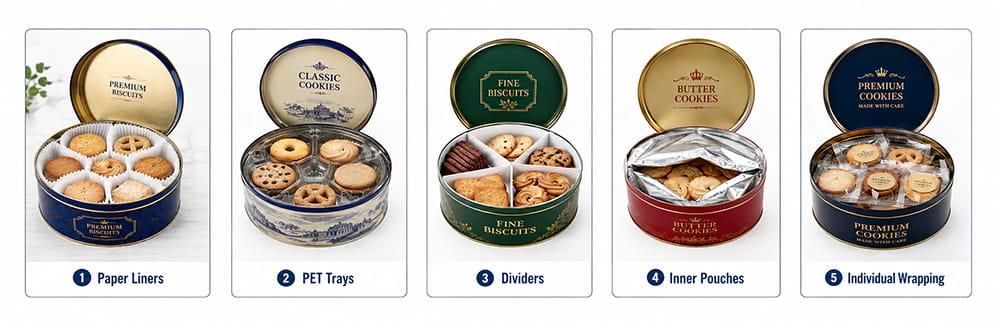
For premium biscuit brands, often the best solution is a metal tin with an inner tray or pouch. The tin gives the outside some structure and branding, while the inner packaging keeps the product fresh and protected.
Food safety considerations should be considered at an early stage of the project when using biscuit tin packaging.
The inside coating and food contact requirements are especially important if biscuits are placed directly into the tin. The tin should be of an appropriate food grade material and use coating systems based on product and target market.
Key points to check are:
For many biscuit brands the safest and most practical structure is to put cookies in food safe inner packaging inside the tin. In this case, the tin provides mainly outer protection, presentation and reusable value.
For brands selling into the EU, U.S., or other regulated markets, material documents and food-contact requirements should be confirmed before mass production.
Biscuit tins are often purchased as gifts, so appearance matters. A good design should make the product look delicious, trustworthy, and suitable for the target market.
This can include:
Common surface finishes include:
A glossy finish makes colors brighter and can be useful for festive or retail-heavy packaging.
A matte finish provides a softer and more premium look. It is often used for artisan or high-end biscuit brands.
Metallic effects can add a luxurious feel, particularly for gift packaging and seasonal collections.
Raised and recessed logos give a tactile effect and add perceived value.
Old-fashioned biscuit tins evoke nostalgia and emotional connection, especially with traditional butter cookies or heritage brands.
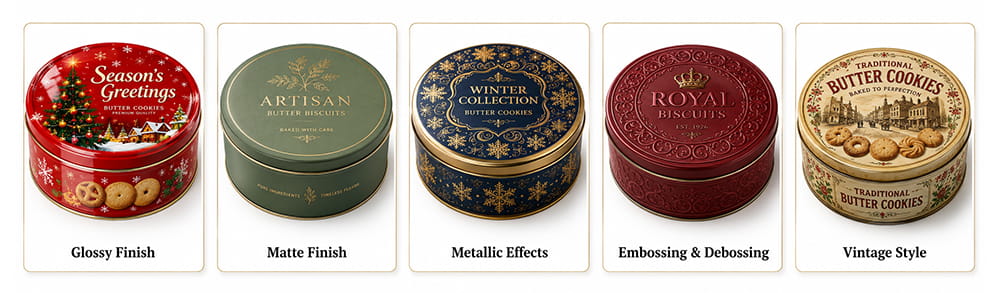
The presentation of a good biscuit tin design should be attractive and the product information should be communicated clearly.
Biscuit Tins Different packaging priorities exist for different sales channels. A tin designed for supermarket shelves might not be ideal for e-commerce shipping, and a tin designed for luxury gifting might not be cost-effective for bulk wholesale.
| Sales Channel | Packaging Priority | Recommended Focus |
| Supermarket retail | Shelf impact and clear product information | Strong front design, barcode area, product name, and flavor visibility |
| E-commerce | Transport protection and dent resistance | Strong tinplate, inner protection, and export carton testing |
| Gift market | Premium appearance and reuse value | Embossing, metallic effects, seasonal artwork, and collectible design |
| Wholesale distribution | Capacity, cost control, and packing efficiency | Existing molds, rectangular tins, carton utilization, and repeat production stability |
The cost of biscuit tin packaging is influenced by a number of factors: tin size, tinplate thickness, shape complexity, existing mold or new mold, printing colors, surface finish, embossing or special effects, inner tray or insert, order quantity, export packing requirements. For new brands, the most practical starting point is usually to use an existing mold. It reduces tooling cost, shortens sampling time and allows the brand to test the market faster.
Custom molds can help established brands develop stronger differentiation. This is especially useful for exclusive gift packaging, seasonal collections, and long-term retail programs.
Buyers always have to ask for samples before mass production. Samples help verify size, lid fit, printing color, coating quality, product capacity, and packing stability.
A reliable biscuit tin manufacturer should do more than produce the box. The supplier should help you evaluate structure, size, material, printing, food safety, and export packing.
Before you ask for a quote, please consider the following:
When you are speaking to potential suppliers, ask these questions:
Many problems in production can be avoided if there is good communication early on.
Biscuit tin packaging is not just a protective container. It impacts product freshness, breakage rate, shelf appeal, consumer experience and brand value.
The best biscuit tin isn't necessarily the most decorative. It is the one that suits your type of cookie, sales channel, food safety requirements, budget and brand positioning.
The best way to go about it is to select packaging according to actual product requirements for biscuit brands and wholesale buyers: What kind of biscuit are you packing?
When these questions are answered clearly, biscuit tin packaging becomes more than a box. It is a practical tool for safeguarding quality, improving presentation and building brand recognition long-term.
Metal tin containers, also called as biscuit packaging, is used to store, protect, display and sell biscuits or cookies. The tins are usually made from food-grade tinplate and can be customized to include printing, embossing, inner trays and a variety of finishes.
Yes, biscuit tins can be suitable for food contact, provided they are made with suitable food grade tinplate and inside coatings. Where biscuits come into direct contact with the tin the food-contact requirements should be confirmed prior to production.
It depends on the product. Round tins are common for classic cookies and gift packaging. Rectangular tins are good for large cookie sets, assortments and efficient carton packing. Square tins are good for stackable retail display.
Choose size according to cookie diameter, thickness, quantity, wrapping method, tray design and empty space required. Do not select by weight alone.
Yes we do fully customised biscuit tins with CMYK printing, Pantone colours, matte or glossy finish, embossing, debossing, metallic effects, special shapes, window lids, trays, liners and dividers.
Yes. Tinplate is recyclable and biscuit tins are often reused by consumers for storage which adds long term value to the packaging.
For new brands, existing molds are usually cheaper and faster. A new mold can provide more differentiation for established brands in search of exclusive packaging.
Cookie size, product weight, packing method, target market, artwork idea, order quantity, inner packaging needs and shipping destination. This helps the manufacturer to recommend the right tin structure and quotation.
If you are considering a biscuit tin packaging project for butter cookies, chocolate cookies, oatmeal cookies, assorted biscuits, gift sets or wholesale bakery products, the best starting point is to confirm your product size, packing way, inner structure, artwork direction, order quantity and destination market.
Professional biscuit tin manufacturer can help to evaluate mold options, material, coating, printing, inserts, sample requirements and export packing before you start mass production.
Tell us about your custom biscuit tin packaging project or ask for a sample.
Holen Sie sich die neuesten Informationen und Sonderangebote


 IPv6-Netzwerk unterstützt
 Deutsch
 English
 Français
 Español
 Português