
A clean, dented tin can, with chipped mints and powder along its bottom seam. Determine if that damage happened during filling, closing, transport or use before replacing the box.
A liner may be helpful to add. Perhaps another depth of tin, a different pouch fold or more delicate handling at the filler. What constitutes useful change depends on where the damage begins.
For pressed mints, start with the actual product batch and the full packaging specification. Remember the target net weight or piece count throughout the investigation.
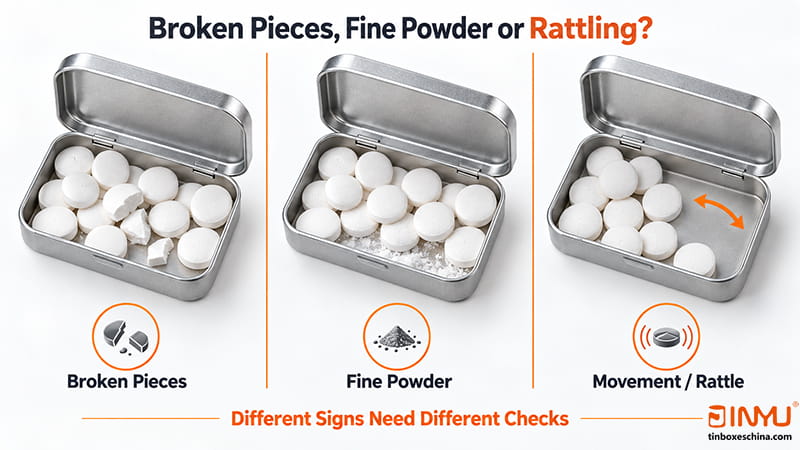
Describe what you see and select a solution. These observations may indicate various checks:
| Observation 1 | Possible contributors: | Initial comparison |
| Chipped edges or broken pieces | Existing defects, impact or local pressure. | Product condition before filling, after filling and after closing |
| Few broken pieces - fine powder | Slight edge loss or surface wear Existing powder | Initial powder level relative to similar handled samples |
| Distinctive rattle | Mints touching each other or the tin; movement of the lid or other parts | Contents inspection Empty and filled tins |
Enquire of the confector if any surface powder is to be expected on the mints supplied. The mere existence does not prove new damage.
Sound is just an observation as well. Check if a quieter sample also has less damaged pieces. The liner can change the sound of the contact without necessarily providing enough protection.
Put checks around the actual filling process:
Check a sample of the mints before feeding for powder, cracks and chips.
After conveying and counting or weighing: watch for changes caused by transfer points, hoppers and chutes for discharge.
After filling, before closing check if damage is caused by entry into the tin or pouch.
After closure: inspect the top layer, the rim area and any folded packaging.
After distribution: Compare contents with condition of tin and shipping carton.
Use comparable, independent samples at each stage. Repeat the same part for inspection, causing extra wear. Record batch identity fill quantity storage conditions handling history
Good evidence is factory retained, unopened delivered packs and customer returns. A new controlled comparison may still be needed because the two have different histories.
Filling is worthy of attention even if the complaint is about the tin. Equipment supplier Ishida identifies changes such as reduced drop heights and hopper and discharge geometry for gentler confectionery handling. Ishida Confectionery Handling Instruction
If the incoming product differs from batch to batch, include the confectioner. Packaging, product texture and strength may also need to be investigated. Confectionery testing can investigate properties such as hardness and fracture behaviour. Stable Micro Systems. Testing Confectionery.
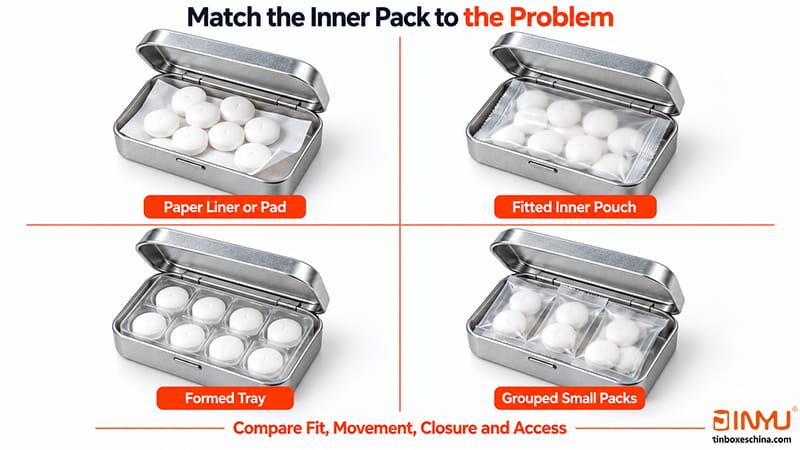
Keep the agreed fill quantity fixed when you are comparing packaging candidates. To add more mints to a quiet tin changes the specification and cost of the product.
“See how far the stuff can travel, where it touches the metal and what happens when it closes. A different depth or footprint may help but the highest point of a folded pouch can matter more than the apparent empty space elsewhere. Use our mint tin size guide to find out the total fill versus usable space.
Example of design: a sealed pouch within a hinged tin, but the folded seal is over the top layer of mints. Chips are off close. A useful trial would be to keep the tin, mints and fill quantity the same but vary the position of the fold. Inspect the seal for integrity, then compare the closure and product status to the original configuration.
Check the lid itself too. Compare fit, effort to open and tendency to move before and after handling. If the lid itself moves a lot, check the fit of the closure. The lid should be able to sit in the usual way over the normal fill variation without the mints having to be compressed.
Select a candidate by the contact or movement to change. The name of the material alone does not predict the outcome.
| Option | What it might help change | What needs to be checked |
| Liner or paper pad | mints in contact with certain metal surfaces | Coverage, paper travel, local pressure and continuous contact mint to mint |
| Inner pouch fitted | Contact of the tin and movement of the filled part | Closure, removal, movement in the bag, folded seals |
| Formed or compartmented tray | Placement of certain items or smaller bags | Fit, contact points, loading effort and if the structure has some useful cushioning |
| Small packs (individual or grouped) | Interaction between different pieces or groups. | More volume, wrap performance, fill steps and consumer access |
It also keeps the tin looking cleaner if the powder stays in a pouch. At evaluation , open the pouch and look at the mints to see what happened to them .
Check suitability for intended food contact and check for odour, loose fibres or particles for added components. Include the last component in fill and close trials. It can be difficult to place a pad that works, when arranged by hand, on the line consistently.
Test the filled tin in the packaging it will be shipped in. Check carton clearances, dividers, layer pads and the packing arrangement. Check to see if the damage is localised to specific carton locations and if the tins have shifted or become misshapen.
Select the test programme for the distribution channel. ISTA differentiates between preliminary screening and simulations of specific shipping environments, with its 3A procedure focusing on parcel delivery. The lab can help select appropriate handling, vibration and compression exposures for the shipment. ISTA test methods.
After opening use separate packs through agreed stages: full, partly used and near empty. Keep the inner pouch in place if this is the way consumers will use it. Check out dispensing, access to the last pieces, folding the opened pouch back inside and re-closing.
Specify any repeated carry or movement exercise so candidates can be compared fairly. One can shake hands to make a problem known; but to say it is a week in a pocket requires proof. As the pack empties some movement is expected; assess its effect on the mints and the user.
Start with the current pack, as a control, and a short list of practical alternatives. When diagnosing, change one main factor at a time where possible. If several changes are made together, the result is initially consistent with that combination.
Agree inspection method and acceptance criteria with confectioner and filling partner before testing. Pick repeated samples for the decision with the same product and initial conditions.
Make a list of 4 things:
Product damage: differentiate whole pieces, chipped pieces and fragments according to agreed definitions. Fragment count alone does not tell you how many original mints broke.
Powder: Use the same method of separation and collection every time and a balance appropriate to the small amount involved. Take into consideration powder at the start and record fill mass.
Condition of package: lid seating, opening effort, inadvertent opening, deformation and damage of the pouch or insert.
Compare sound and use under the same move fill & listen conditions then check access & reclosure.
Photograph the contents before disturbing the placement. Collect powder with as little extraneous handling as is practical, so that the inspection itself does not become another abrasion test.
Back to the folded-pouch example. If repositioning the seal improves one sample, repeat the comparison, check the intended filling process and carry out the relevant transport assessment of the revised complete pack.
Compare material cost, packing effort, filling speed, tooling implications and ease of use once candidates meet agreed protection requirements. Keep together the approved drawing, samples and trial records.
It may have been introduced with the mints or developed during filling, transport or use. Compare samples from consecutive stages. The location where a powder is found does not by itself tell us where it came from.
Rattling does require inspection, but not necessarily breakage. Check the lid and other moving parts. Check the mints and compare powder levels.
It can cut travel at the same fill weight. It may also create pressure and impede closure. Try the whole pack including sealed and folded pouch
It may be useful when contact with a particular metal surface contributes to damage. It’s position and coverage matter. Mints can still hit each other and a misplaced pad can affect closure.
Mints in a common bag can still move against each other. Even if the surrounding tin is clean and the pack sounds quieter after testing, inspect the contents of the bag.
The thickness may affect the tin can deformation resistance. Fit, contact, closure and handling also contribute to the protection of the content. Determine the failure you are trying to address before changing the material specification.
Ishida — Confectionery Weighing, Packing & Quality Control Machines
Stable Micro Systems – Confectionery products – Texture testing
Jinyu can review tin structure, dimensions and inner-pack fit for your mint and gum tin packages.
Send us your packaging brief including photographs of the intact and damaged mints, the target fill, current tin and inner packaging and where the problem first appears. Include filling way, shipping arrangement and required order quantity. Label physical samples with batch and handling history.

Holen Sie sich die neuesten Informationen und Sonderangebote


 IPv6-Netzwerk unterstützt
 Deutsch
 English
 Français
 Español
 Português