
A fruit gummy, a peppermint and a milk chocolate can all sit quite happily together in a gift tin. The colours work, the pieces fit and the lid shuts. It's a different kind of checking to see if they still taste as they should after storage.
One tin can be for different sweets. The packaging decision is whether they can also share the same air space, or whether some require their own sealed inner packs.
A divider can help keep the display tidy and moisture and aroma can move between its compartments. You can bag the whole assortment to protect from the outside environment but leave the sweets inside exposed to each other.
Start with real products with expected shelf life. Those requirements should determine the arrangement, inner wraps and tin size.
“Mixed sweets” offers a packaging supplier very little to go on. A flavour description may be identical but a soft caramel, a hard toffee and a chocolate-covered caramel have different surfaces and structures.
Ask the confectioner for each sweet’s formulation category, surface treatment, water activity, storage requirements and any shelf-life information that is already known. Write down the number of each kind that is loose, twist-wrapped or sealed.
Include the layer. Sour powder, sugar crystals, oil and chocolate affect the way the pieces touch and the cleanability of the pack.
The combinations below are a good place to start review. They are not universal pass / fail buckets.
| Proposed selection | First questions to consider | Options to Compare (inner-pack) |
| Hard candies and gummies | Will either product absorb or lose moisture? Will the candies become sticky? | Individual sealed packs for each product type |
| Milk chocolate and peppermint | Does the chocolate maintain the desired flavour during storage? | Suitable aroma resistant sealed pack around the mints, chocolate packaging also reviewed |
| Various gummy flavours | Is water activity like surface coatings and flavour intensity? | One bag for all or separate bags of flavour |
| Sour Coated Candy & Smooth Candy | Will loose powder move to or accumulate on neighbouring pieces? | Single Wraps or Small Bags |
| Sweet in original packing | Are the wraps sealed? Are they suitable for the new storage conditions? | Maintain current packs and then trial full range |
The confectionery producer already has the information needed to avoid unnecessary packaging changes. A sealed wrapper proven may be suitable to retain. A review of a decorative twist wrap is required.
Water activity is a measure of the availability of water in a food. It is useful for predicting the direction of moisture exchange; moisture content is a measure of how much water is present.
At the same temperature, moisture will move from a product with higher water activity to a product with lower water activity. The sweeter one may appear drier, but looks can be deceiving. The one with lower water activity is not necessarily the sweeter one. This is explained by AQUALAB’s moisture-migration guidance.
Take a gummy and a crisp product with different water activities. Taking the moisture out of the gummy could make it more firm. The crispy bit can lose its texture as it soaks up moisture. This is why biscuit additions are worthy of attention in a confectionery gift assortment: research on stored biscuits links moisture uptake with loss of crispness. Studies on moisture adsorption on biscuits.
No direct contact is necessary. A normal air space (such as the space above an open divider) allows moisture to move.
A tightly closed outer pack does not do away with that inner route. Related aspects of the storage problem are the moisture exchange between the components of the mixture of the packaged foods and the exchange through the outer packaging. The same distinction is useful in designing a mixed sweet tin. Study of moisture migration in packaged multi-component foods.
Compare measured values with intended texture and storage results. One water activity difference should not be an overall guideline to accept or reject a combination.
The issue of aroma is still unresolved regarding moisture compatibility.
If the peppermint and milk chocolate are supposed to taste different, check to see if the chocolate develops any hint of mint during storage. It’s the taste of each sweet that matters, not just how powerfully the tin smells when you open it.
Aroma compounds may also interact with packaging materials. Some compounds are absorbed by the packaging, which changes the taste left in the product. This is called flavour scalping and has been studied in polyethylene sealant materials. Studies on flavour scalping by polyethylene sealers.
That’s not to say that all polyethylene bags are unsuitable. So “clear plastic bag” is an inadequate specification for a product where aroma is important.
Provide the film supplier with the flavour profile and storage conditions. What evidence is there for the proposed structure? Evaluate the wrapped products together A thicker film or a decorative foil finish does not guarantee that the finished pack will keep out unwanted flavour transfer.
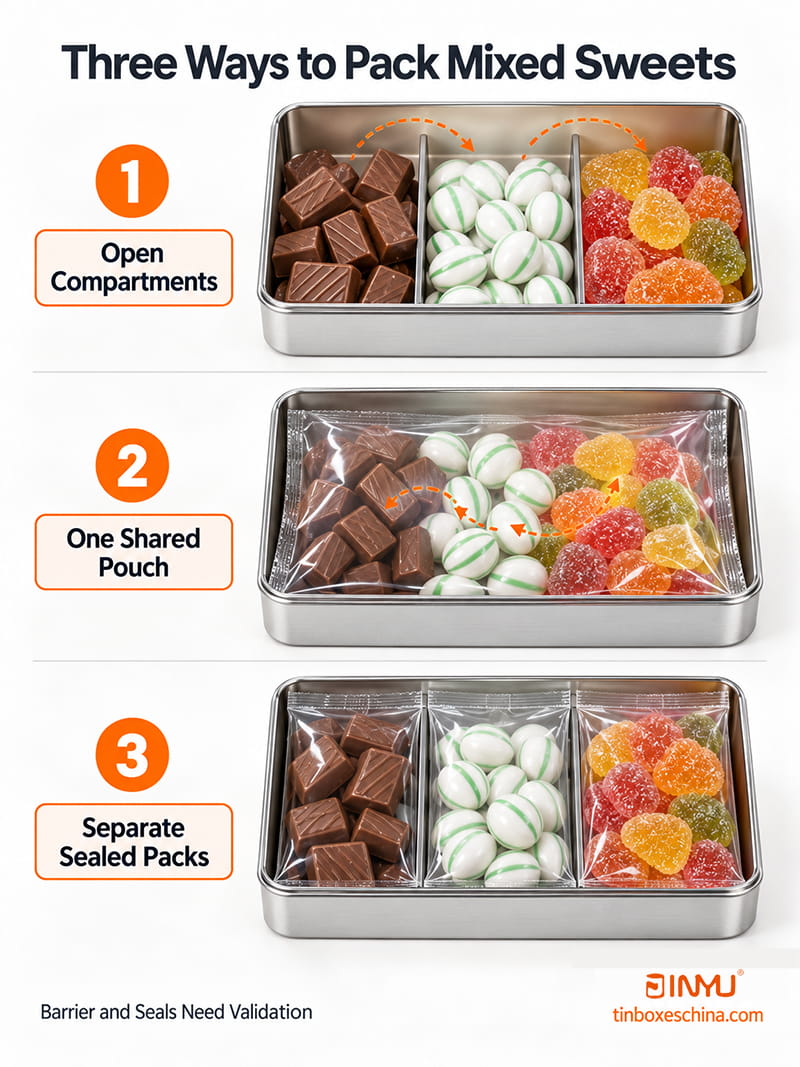
Draw the inside of the tin and mark which sweets have an air space. This makes it easier to compare the packaging options.
A paper divider, an open plastic tray and a metal cross-divider all offer a path above their compartments. Metal itself is a strong barrier, but an open metal partition does not make a sealed chamber.
| Internal layout | What it adds | What remains to be checked |
| Paper cups, greaseproof bags or wax wraps | Presentation, easier handling and reduced contact or sticking, depending upon the material | They should not be considered a sealed moisture or aroma barrier |
| Plastic, paper or metal bins, uncovered | Less contact among pieces and placement | Sweets may still share the air about |
| Wraps with folded or twisted ends | Handling and separation of individual | Closure and Barrier Performance, twist is not heat seal |
| One sealed bag of the set | Protection of group from outside environment | Exchange between the products in this pouch |
| Sweet type sorted in sealed pouches | Separate internal packing areas | Suitability for film, seal integrity, filled size, and storage performance |
| Individually wrapped or separate tray cavities | Part or portion protection | Performance of the real barrier, efficiency of filling, opening and cost |
A whole-assortment bag is handy if the sweets in the bag go together. The sealed boundary must be between the relevant products where separation is required.
One thing you can do is to wrap each piece individually. Another is to put compatible sweets in small sealed pouches. Compare both against your intended serving size, the display and the filling process before you decide.
A helpful inner-wrap spec covers material, closure and finished package. Only giving a material name leaves too many possibilities.
Request water-vapour transmission data for moisture-sensitive confectionery at the specified test temperature, humidity and film structure. Compare the results of similar conditions. Those figures are for the material, the filled pouch still has to be checked.
Discuss aroma retention and unwanted transfer separately from moisture and oxygen transmission for unique flavours. A good outcome for one does not necessarily translate into the others.
Check release from wrapper, grease resistance and condition of neighbouring packaging for sticky or oily sweets. Greaseproof or waxed paper may help in handling but whether it provides a sealed barrier will depend on the actual structure and closure.
Confirm also the method of packing. Flow-wrap is a wrapping process that usually results in a pillow style pack with sealed ends. It does not use a specific film, or imply that nitrogen has been added. Check the sealing area for possible entry of sugar, sour powder or oil.
Where nuts or sensitive fat-rich fillings are incorporated, oxygen control may be an additional concern. Oxidation is a chemical degradation process, not a moisture or aroma transfer process. Nitrogen flushing can reduce oxygen in pack at sealing . Continued protection is dependent on packaging and closure . The technical guide MAPAX of Linde deals with coordinated decisions regarding the choice of gases and packaging materials.
There is another question for sweets touching the tin or insert directly: is that material fit for the intended food contact? Confirm coating or insert specification for food and contact conditions. Clear and gold are appearance descriptors, not a full suitability assessment. FDA guidance also is based on substances and their permissible conditions of use for food-contact compliance. Food-contact Material Guidance (FDA)
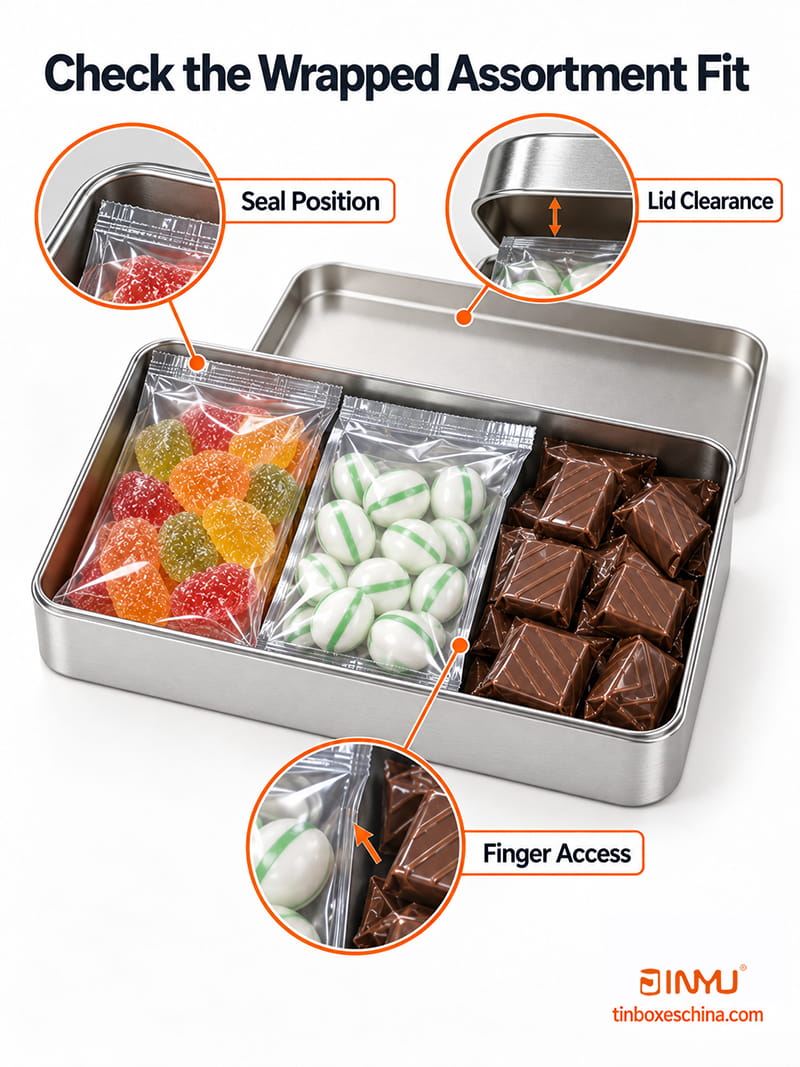
After the inner-pack approach is established, use filled samples to confirm tin size.
Wrapper tails, pouch seals, folded corners take up room. So does the air retained from inflation. When the finished packs arrive, a layout drawn around bare sweets can be difficult to assemble.
Check the real sequence: put the first pouch, put the others, put any insert, fold the seals and seal the lid. Then open it and remove one piece. Look out for:
Seals bent over sharp edges or caught in the lid channel;
Above its compartment a pouch bulged;
Packs around compressed by chocolate;
Small, hard sweets moving under a bigger bag;
An insert that pops up when the consumer pulls out a bag.
Allow adequate clearance for normal filling and folding variations. A sample that only closes after a careful rearrangement for production needs further work.
This review should include lid choice. Light protection from a solid lid. A window is useful when the last inner package has something worth showing. If the sweets are going into an opaque pouch decide what you want the buyer to see through the window before you buy it.
The metal body is a strong barrier. The lid, seams and any window determine how the complete tin performs. Shelf-life result cannot be determined by tightness of the lid or presence of a gasket alone. The tin and inner packaging do not replace temperature control where required by the sweets.
Picture a gift tin packed with fruit jellies, peppermints, and milk chocolates. This is an example of development, not a customer trial reported.
The first is an open tray with three compartments. It gives each variety a position and stops the chocolates from moving around. The next decision is where to put the inner wraps.
The gummies can be packaged in a sealed pouch chosen for their moisture requirements. Peppermints might have a separate sealed pack, which is evaluated for aroma performance together with the chocolates. The existing packaging of the chocolate would also be considered for the proposed combination and storage conditions.
The tray would then be sized to the filled packs. It may need a deeper gummy compartment, room for the seals of the mint pouch and a finger recess to remove the chocolate.
Once assembled, the team would compare the sweets with controls stored separately. The layout suggested would be provisional until supported by those checks.
The next step could be smaller pouches, a different layout or a printed lid if the bags hid the display they were meant to show. If you take off the necessary internal protection to reveal the sweets, the original compatibility question remains.
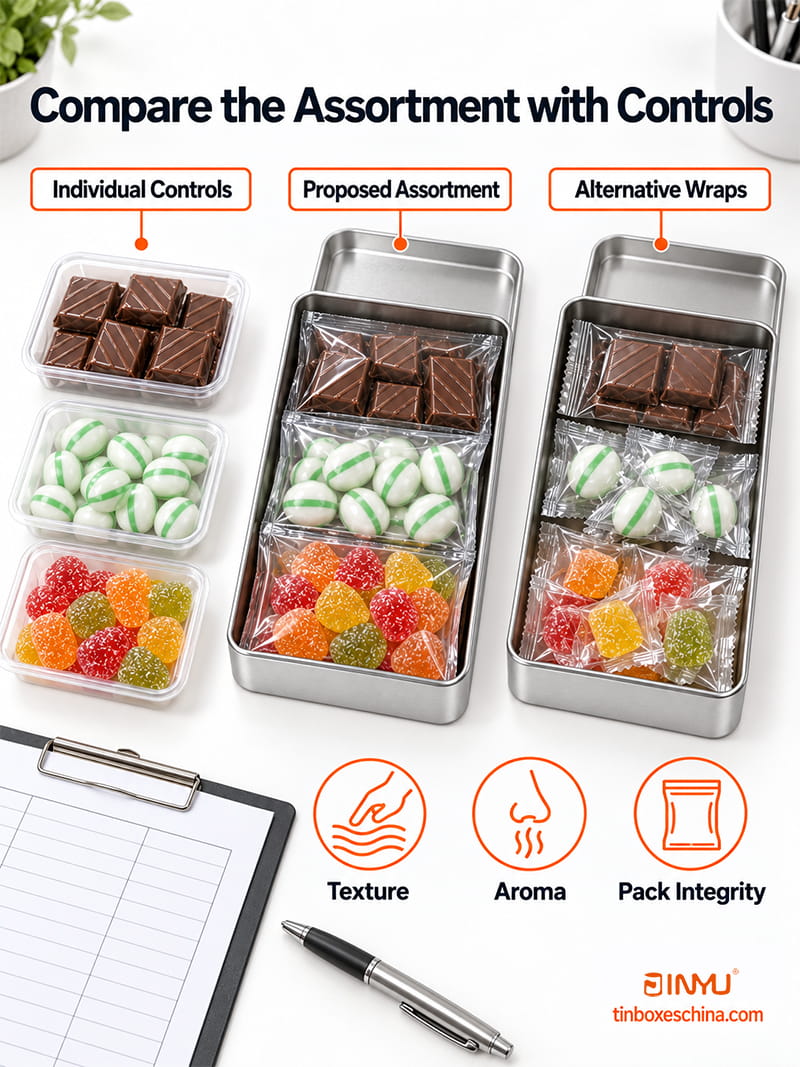
Representative production lots of sweets should be used and the proposed counts and proportions of pieces should be clear. It is not representative of an assortment of mostly gummies to sample one gummy and many hard sweets.
Create three groups:
Each sweet individually kept in its respective packaging as a reference;
The entire range in the proposed retail pack;
Another assortment pack if you are considering another wrapper or separation method.
Record initial condition prior to storage. At planned intervals compare texture, stickiness, coating condition, appearance and flavour of each variety. Carry out successive checks using separate unopened samples and samples intended for repeated-opening evaluation.
For aroma, coded samples evaluated without knowledge of the packaging arrangement can minimise expectation bias. Appearance is recorded in a photograph but the photograph cannot establish that the chocolate has retained its original flavour.
Look at the pouches too. Check for wear, trapped powder and damaged seals. Seal strength testing and leakage testing are different questions. ASTM F88/F88M gives a method for testing seal strength and the acceptance range should be appropriate for the package and its opening requirements. ASTM F88/F88M.
The real-time storage should reflect the desired market conditions. Stress screening can help to identify weaknesses earlier, but its results require a validated basis before they can be translated into a shelf-life claim. A few weeks without visible change do not, by themselves, prove full shelf life. Microbiological requirements should be defined by the confectionery producer at the same time as these quality checks.
If you want a sharing tin simulate the removal of one variety and leaving the others. Note which packs are still sealed and if consumers can easily reclose opened packs.
Finally, inspect the assembled tin in its actual shipping configuration after distribution testing. If the tray edge rubs through an otherwise acceptable inner pouch in transit, it is compromised. This guide to testing gummy candy packaging in tins before going into full-scale production covers the wider pouch-fit, sealing and transport checks.
Discuss acceptance criteria with the product owner before looking at the results. Retain the approved range, wrapping specifications and packing pattern. Modifications to flavours, recipes, proportions, wrappers or conditions of distribution should lead to a re-evaluation of what needs to be retested.
Yes, with a layout that is supported by real products and storage requirements. Compare their water activities and assess changes in texture. Where problems are caused by sharing an air space separate sealed packs can be considered.
An open metal divider does not form isolated sealed spaces. Aroma can travel through the air above or around it. They need to be built differently and validated separately. " Independently sealed compartments.
It can be good for a compatible assortment. It prevents the cluster from the outside world, but allows the sweets in it to interact.
Don’t think so. Different closures are used such as a twist ended wrap and a continuously heat sealed pack. Check the purpose of the wrapper and evidence for the needed storage period.
Moisture, aroma, oxygen and handling requirements, plus sealability and opening determine the choice. COMPARE PACKAGING OPTIONS. Neither "foil" nor "individually wrapped" is a complete specification.
That date is a starting reference, not automatic validation. Combining products or changing their original packaging can lead to new quality limits. The shelf life of the final assortment should be established by the product owner.
Check the change. The existing assessment can be influenced by a new flavour system, coating or recipe. Use the previous evidence to decide what checks still apply and what need to be repeated.
If you are doing a mixed sweet tin project, send Jinyu the product list, quantity of each variety and current wrapping method and the dimensions of the filled inner packs. Specify the desired shelf life, the target market, the necessary storage conditions and the preferred presentation.
We can assist in reviewing tin dimensions, available mould options, insert layout, pouch clearance, lid fit and export-carton layout. Talk to your confectionery producer and packaging supplier about product stability and inner-wrap performance.
Browse our range of tin boxes for candies and chocolates or send us your assortment details for a packaging review.
We start custom production at 5,000 pieces. Normal sample preparing time is 7-10 days. Mass production is generally 25-35 days after sample approval. Plan product storage validation independent of those manufacturing lead times.
AQUALAB. How to predict moisture migration with water activity.
Food Chemistry. Moisture adsorption behaviour of biscuit during storage investigated by using a new Dynamic Dewpoint method.
Journal of Food Engineering. The dynamics of moisture migration in packaged multi-component food systems I: shelf life predictions for a cereal–raisin system.
Food Packaging and Shelf Life. Flavor scalping by polyethylene sealants.
Linde. MAPAX solutions for packaging in modified atmosphere.
U.S. Food and Drug Administration. Determining the Regulatory Status of Components of a Food Contact Material.
ASTM International. F88/F88M: Standard Test Method for Seal Strength of Flexible Barrier Materials.

Holen Sie sich die neuesten Informationen und Sonderangebote


 IPv6-Netzwerk unterstützt
 Deutsch
 English
 Français
 Español
 Português